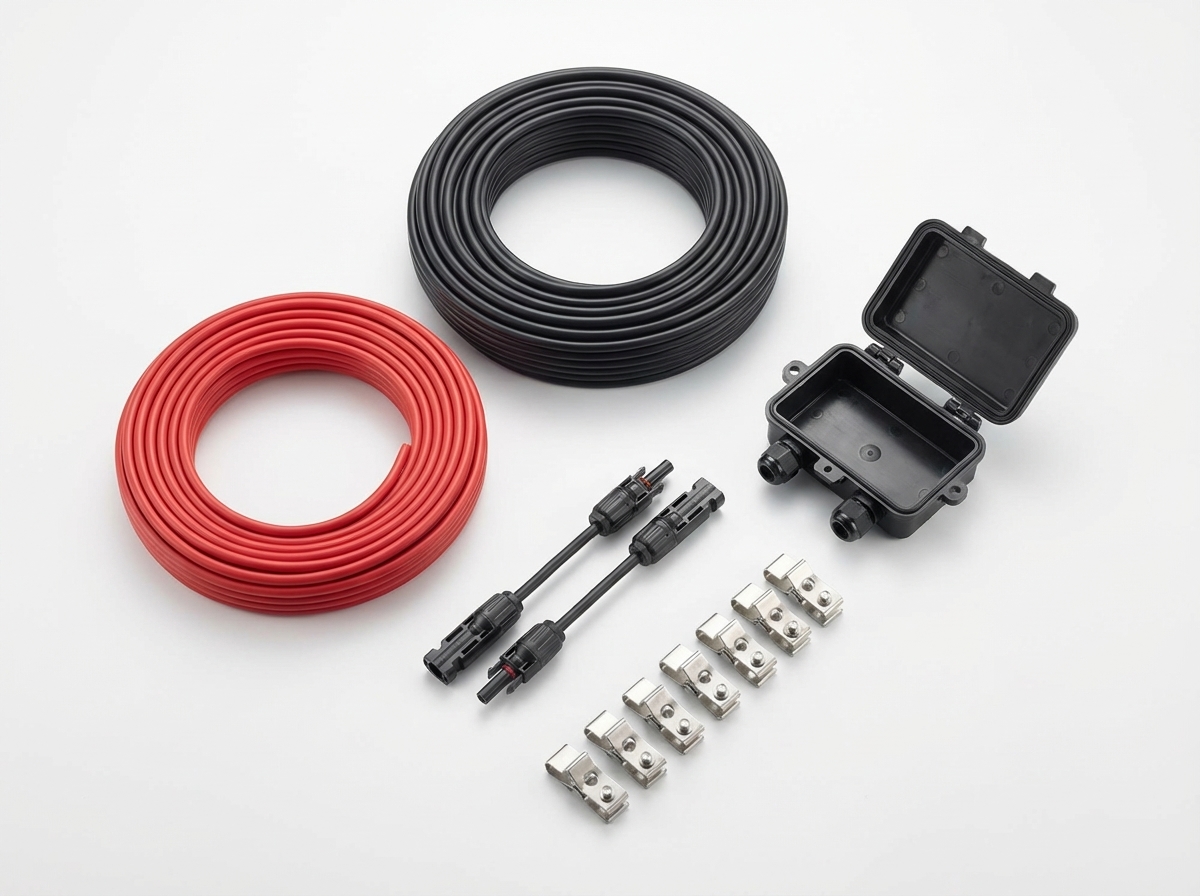
Most writing about combiner boxes explains what to specify. Very little describes what buyers actually do — how many suppliers they run at once, how often they order, and how much of the specification is nailed down by the time goods move.
We looked at 785 combiner box export records covering 383 buyers over an 18-month period, and the procurement behaviour they show is different from how the purchase is usually described. Parallel sourcing is normal rather than exceptional, buying happens in short project-driven bursts rather than steady cycles, and the voltage class — the single parameter that determines whether the internals are safe — is absent from roughly nine out of ten shipment descriptions.
Method and limits
Read this first, because it defines what the numbers can and cannot support. The dataset is 785 shipment records from Chinese exporters, dated January 2025 to July 2026, with destinations worldwide, covering 383 distinct consignees. Records were de-duplicated on shipment identifiers, and consignee name variants (differences such as "SDN BHD" versus "SDN. BHD.") were normalised before counting.
It is filtered on one product description: only records describing the goods as "combiner box" are included. Shipments described as "array box" or "string box" are not captured, and because those terms are used more often for utility-scale equipment, larger installations may be under-represented here.
It cannot support price analysis. Unit price appears in roughly 27% of records and trade terms in roughly 16% — too sparse to say anything honest about pricing, so this analysis makes no pricing claims. And it is a sample, not a census: 785 records from one HS code and one data source is a window onto the trade, not a measurement of it. Every figure below describes this dataset, not the global market. No buyer is named anywhere; all findings are aggregate.
Finding 1 — Active buyers run several suppliers at once
Among the twelve most active buyers in the dataset, eight sourced from between two and four different Chinese suppliers within the 18-month window. Only four used a single supplier throughout.
This contradicts how supply relationships are often described. Buying from several suppliers in parallel is not a sign that a relationship has failed or that the buyer is shopping purely on price — among the buyers doing the most business, it is the normal pattern. If you are single-sourced on combiner boxes, you are the exception among active buyers, not the rule.
Finding 2 — Buying happens in bursts, not cycles
Across those same twelve buyers, most concentrated their shipments into one to four active months out of eighteen. Only one spread purchasing across seven separate months.
Combiner box procurement tracks project milestones, not inventory replenishment. A buyer places several shipments while a project is being built, then goes quiet until the next one is funded. For buyers, that means lead time should be planned against project milestones rather than negotiated as a standing stock arrangement. For suppliers, a buyer silent for six months has probably not switched away — they are between projects.
Finding 3 — The market is a long tail of one-off buyers
383 buyers account for 785 shipments — an average of roughly two shipments each. Around 82% of the buyers fall into the lowest activity tier, typically one or two shipments in the entire 18-month window. Sustained repeat purchasing appears in only about 3% of buyers.
This explains something that otherwise looks like carelessness. If most organisations buy combiner boxes once or twice per project cycle, very little institutional knowledge accumulates between purchases. The specification work effectively starts from scratch each time, often under schedule pressure — exactly the condition in which incomplete specifications get sent out. The buyers who do this well are usually the ones who kept a written specification from the last project, not the ones who happen to know more.
Finding 4 — Nine in ten records state no voltage class
Of the 785 records, 57 mention 1000V and 13 mention 1500V. The remainder carry no voltage class in the product description at all.
Shipping descriptions are not engineering documents, so some of this is simply how paperwork is written. But the pattern is consistent with what shows up at the quotation stage: the voltage class is frequently the last parameter to be pinned down, and sometimes it is never stated explicitly — it is assumed from the inverter selection. That assumption is where 1000V-rated internals end up inside a box destined for a 1500V array, which is a safety failure rather than a documentation problem.
The naming inconsistency compounds it. The same physical product travels as "combiner box", "array box" and "string box" depending on the exporter, so a buyer comparing quotations across suppliers may be comparing differently-named descriptions of different configurations without realising it.
Finding 5 — Where these shipments actually go
By region, the dataset breaks down roughly as: Africa 31%, Southeast Asia 29%, Latin America and the Caribbean 15%, North America 14%, South Asia 7%.
Africa being the single largest destination region is not what most industry commentary would predict, and the country spread within it — Kenya, Zambia, DR Congo, Tanzania, Nigeria, Uganda, Ghana — points at commercial, industrial and off-grid installations rather than utility-scale plants. That destination mix is internally consistent with the voltage picture above: distributed and C&I systems are predominantly 1000V-class, so a flow dominated by those markets would be expected to carry mostly 1000V-class equipment.
Finding 6 — Ranking trade data by volume is misleading
Fifteen of the highest-volume consignees in the raw data were removed before analysis, because they were not buyers of combiner boxes in any meaningful sense. They included contract electronics manufacturers assembling on behalf of brands, a telecommunications infrastructure company, a competitor’s own overseas subsidiary, a semiconductor equipment firm, a battery brand’s own regional arm, a hotel carrying out a self-build, and freight and exhibition logistics companies.
Between them, these entities would have occupied most of the top of a volume-sorted list. Anyone using trade data for supplier or customer research should take this as the main practical warning: sorting by shipment count surfaces logistics artifacts and intra-company transfers first, and real buyers only after those are stripped out.
What this means if you are specifying combiner boxes
The behaviour in this data suggests four things worth doing.
- Write the specification down and keep it — because most organisations buy infrequently, last project’s specification is the only institutional memory you have
- State the voltage class explicitly and apply it to every internal item; do not let it be inferred from the inverter
- Send the same internal bill of materials to every supplier you compare — parallel sourcing only helps if the quotations describe the same configuration
- Plan lead time against project milestones; buying is bursty by nature, and the constraint is the start of a build
What the shipment records show
| Pattern | What this dataset shows | What it means for procurement |
|---|---|---|
| Supplier count | 8 of the 12 most active buyers used 2–4 suppliers in 18 months | Parallel sourcing is normal among active buyers, not a failed relationship |
| Purchase rhythm | Most concentrated shipments into 1–4 active months out of 18 | Buying is project-triggered; plan lead time against milestones |
| Buyer depth | 383 buyers across ~785 shipments; ~82% in the lowest activity tier | Most purchases are one-off project buys, so specifications restart each time |
| Voltage stated | 57 records state 1000V, 13 state 1500V | Roughly 9 in 10 descriptions carry no voltage class at all |
| Destination mix | Africa 31%, SE Asia 29%, LatAm 15%, N America 14%, S Asia 7% | Distributed and C&I markets dominate this flow |
OmniSol is a solar BOS sourcing integrator working with audited partner factories. This analysis is published as procurement research; the underlying records contain no OmniSol customer data and no buyer is identified.
Procurement decision table
| Decision area | Buyer question | Procurement check | Risk control |
|---|---|---|---|
| Product scope | Which product families does this cover? | Solar Combiner Boxes (all), 1500V DC Combiner Box | Letting the voltage class be inferred from the inverter rather than stated |
| Specification input | What must be stated before comparing quotes? | Keep the written specification from your last project — it is your only institutional memory | Use the same specification wording across supplier quotes. |
| Commercial input | What makes the quote operationally useful? | State the DC voltage class explicitly and apply it to every internal component | Tie quantity, packing and destination to the same RFQ line. |
| Quality gate | What should be checked before shipment? | Solar Combiner Box Guide | Comparing quotations that describe differently-named or differently-configured products |
BOM and RFQ context
How EPCs Actually Buy Combiner Boxes: 785 Shipments is most useful when it is read as a sourcing decision, not only an informational article. The affected product scope normally includes Solar Combiner Boxes (all), 1500V DC Combiner Box. A buyer should connect the answer to a live BOM, because cable size, connector rating, protection device choice, box configuration, storage accessories and export packing can change together.
For a procurement guide, the goal is to turn a broad buying question into a repeatable RFQ structure. The buyer should leave with the required product family, specification fields, quality checks and internal links needed to continue into the central products hub. In an RFQ, the minimum inputs should include Keep the written specification from your last project — it is your only institutional memory, State the DC voltage class explicitly and apply it to every internal component, Send the same internal BOM to every supplier you are comparing, Plan lead time against project milestones, not as a standing stock arrangement. These inputs let a sourcing team compare suppliers on the same basis instead of only comparing unit price.
The related follow-up content is Solar Combiner Box Guide, Solar Combiner Box BOM for EPC, Combiner Box Quality Inspection Checklist. Use those pages to validate standards, sizing, inspection and packing before sending a final quote request. The main risk to avoid is: Letting the voltage class be inferred from the inverter rather than stated Comparing quotations that describe differently-named or differently-configured products
FAQ
Do solar EPCs use one combiner box supplier or several?
In this dataset, eight of the twelve most active buyers used between two and four different Chinese suppliers within an 18-month window; only four used a single supplier. Parallel sourcing is the normal pattern among active buyers rather than an exception, so appearing alongside other suppliers on a buyer’s shipment history is expected.
How often do EPCs actually order combiner boxes?
Infrequently, and in bursts. Most of the most active buyers concentrated their shipments into one to four active months out of eighteen, which indicates project-triggered buying rather than inventory replenishment. Across all 383 buyers the average was roughly two shipments each over the whole period.
What does export data show about 1000V versus 1500V combiner boxes?
In these 785 records, 57 mention 1000V and 13 mention 1500V, with the rest stating no voltage class. Note the limit: the dataset only covers shipments described as "combiner box", and utility-scale equipment is often described as "array box" or "string box", so 1500V equipment is likely under-represented.
Where do Chinese combiner box exports actually go?
In this dataset the regional split is approximately Africa 31%, Southeast Asia 29%, Latin America and the Caribbean 15%, North America 14% and South Asia 7%. Africa is the largest single destination region, spread across Kenya, Zambia, DR Congo, Tanzania, Nigeria, Uganda and Ghana.
Can trade data tell you what a combiner box costs?
Not reliably. In this dataset unit price appears in about 27% of records and trade terms in about 16% — too sparse to draw pricing conclusions from, which is why this analysis makes no pricing claims. Trade data is useful for volumes, destinations and buyer behaviour, not for price benchmarking.