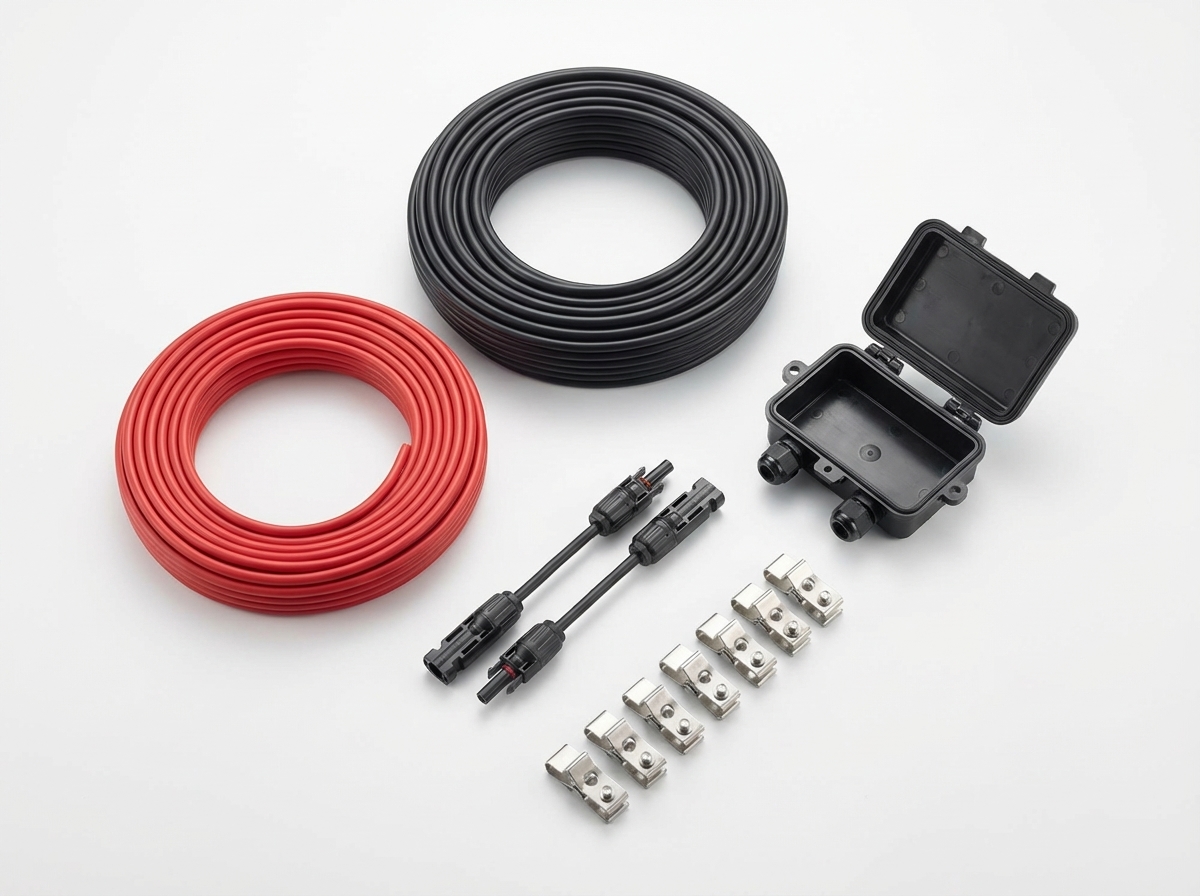
Commercial and industrial solar sits in an awkward gap. It is too large for the residential kit approach — a 500 kW rooftop cannot be built from packaged kits — but too small to command the dedicated engineering support that utility developers get from tier-one suppliers. Most C&I buyers end up assembling the balance of system from four or five separate vendors and discovering the incompatibilities during installation.
OmniSol supplies the electrical and structural balance of system for C&I projects as one coordinated package: mounting, PV cable, connectors, combiner boxes, DC and AC protection, distribution boards and storage accessories, matched to one voltage class and shipped in one consolidated container. We are a sourcing integrator working with audited partner factories, not a manufacturer — which is why the certified components in a package can come from whichever factory holds the right approval for your destination market.
What we supply for a C&I project
The scope is the complete balance of system between the modules and the grid connection. Modules and inverters can be included or left to your own supply, whichever suits the project.
- Mounting: rooftop rail systems, seam and tile clamps, flat-roof ballast frames, ground-mount structures, carport frames
- DC side: H1Z2Z2-K PV cable (4–16mm²), MC4-compatible connectors, T-branch and inline fuse assemblies
- Combiner boxes: 2 to 16 strings in, 1000V or 1500V class, with string fusing, SPD and output isolator or MCCB
- DC protection: gPV string fuses and holders, DC MCB and MCCB, Type 1/2 and Type 2 SPD, load-break isolators
- AC side: AC protection, distribution boards, earthing and bonding components
- Storage accessories where the project includes battery: rack hardware, DC protection for the battery bus
What actually changes from residential to C&I
The component list looks similar on paper and behaves differently in practice. Three things change, and they are the three that cause most commissioning problems.
String count crosses the combiner threshold. Once you run more than two or three parallel strings, reverse current from healthy strings into a faulted one becomes a real failure mode, so string fusing and a proper combiner enclosure stop being optional. Voltage class becomes a decision rather than a default — C&I projects run at 1000V or 1500V DC, and every protection component has to carry a certificate at that class. And protection coordination starts to matter: a fault on one string should clear that string, not drop the array, which requires the fuse, breaker and isolator ratings to be selected against each other rather than individually.
Engineering support included with a project order
C&I buyers usually need the calculations before the authority will approve the installation, and those calculations depend on hardware selection — so they have to happen during sourcing, not after.
- Wind and snow load calculations to AS/NZS 1170.2, ASCE 7-22 or EN 1991-1-4, with governing support spacing for your layout
- CAD layout for the mounting arrangement
- BOM review: missing components, incompatible ratings, and voltage-class mismatches flagged before quotation
- Combiner and DC protection configuration matched to your string design
Certification: why a sourcing integrator helps here
This is the part where being a sourcing integrator rather than a single factory is a practical advantage rather than a disclaimer.
Most international markets accept assemblies built to IEC standards with IEC-rated components inside. The United States requires UL-listed assemblies built from UL-recognised components under the NEC — a different bill of materials and a different document package, not just a different logo. Australia layers AS/NZS requirements on top; the EU requires CE with the applicable harmonised standards. No single factory holds every approval, so a package destined for a specific market has to be assembled from whichever audited factories hold the right certificates for it. That is the sourcing problem C&I buyers actually face, and it is what we exist to solve.
MOQ, container logic and lead time
The commercial obstacle for C&I buyers is rarely price — it is minimum order quantity. A single project needs 40 combiner boxes, not 400, and factories quoting per-SKU minimums make that project uneconomic.
We set MOQ per project rather than per SKU. Because mounting, cable, connectors, protection and accessories consolidate into one mixed container, a normal C&I project BOM usually reaches an efficient shipment volume on its own without inflating any single line. Quotes are FOB Ningbo or Xiamen; lead time is confirmed against the finalised BOM at quoting stage, and staged shipments are available for multi-site rollouts.
How a C&I order runs
Five stages, with the checks front-loaded so surprises happen on paper rather than on site.
- 1. Send the array layout, system size, voltage class and destination market — a rough BOM is enough to start
- 2. Fit and certificate check: missing items, rating mismatches and the conformity scheme for your market
- 3. Structured quote: matched SKUs, per-line FOB price, lead time and packing logic
- 4. Pre-shipment QC: 100% inspection with photo and video report before release
- 5. Consolidated shipment with the full export document set (invoice, packing list, CO, material certificates, test reports)
What the trade data says about C&I BOS
C&I is where the volume actually is. In 785 combiner box export records from Chinese suppliers between January 2025 and July 2026, the destination mix was led by Africa (31%) and Southeast Asia (29%) — markets building commercial, industrial and off-grid systems rather than utility plants. Of those records, 57 mention 1000V and only 13 mention 1500V.
Two practical implications for a C&I buyer. First, 1000V-class equipment is what most of this trade actually moves, so availability and pricing are better there. Second, roughly nine in ten shipment descriptions state no voltage class at all — which is the same specification gap that lets 1000V-rated internals reach a 1500V array. State the class explicitly in your RFQ. Full analysis is in our shipment-data study.
Typical C&I scope by project size
| Project band | Typical configuration | BOS scope focus |
|---|---|---|
| 100–500 kW rooftop | 1000V DC, 4–8 string combiners | Rail/clamp mounting, cable, combiner, DC protection, AC distribution |
| 500 kW–2 MW rooftop or ground | 1000V DC, 8–12 string combiners | Adds MCCB output protection, per-string monitoring, larger busbar |
| 2.3–10 MW ground or carport | 1000V or 1500V DC, 12–16 string combiners | Full 1500V-class protection set, Type 1+2 SPD, IP66 enclosures, staged shipments |
| With battery storage | Shared DC bus | Battery-side DC protection re-rated for battery fault current, not PV current |
OmniSol is a solar BOS sourcing integrator working with audited partner factories. MOQ is set per project rather than per SKU; mounting, BOS and accessories consolidate into one mixed container, quoted FOB Ningbo or Xiamen.
Procurement decision table
| Decision area | Buyer question | Procurement check | Risk control |
|---|---|---|---|
| Product scope | Which product families does this cover? | All Solar BOS Products, Solar Combiner Boxes, DC Protection | Building a C&I array from residential kit logic — string count crosses the combiner and fusing threshold |
| Specification input | What must be stated before comparing quotes? | Array layout or site plan, and total system size in kW or MW | Use the same specification wording across supplier quotes. |
| Commercial input | What makes the quote operationally useful? | DC voltage class (1000V or 1500V) — stated, not inferred from the inverter | Tie quantity, packing and destination to the same RFQ line. |
| Quality gate | What should be checked before shipment? | Solar BOS Calculator (BOM from array layout) | Mixing 1000V-rated components into a 1500V system to save cost |
BOM and RFQ context
Commercial & Industrial Solar BOS Supplier (100kW–10MW) is most useful when it is read as a sourcing decision, not only an informational article. The affected product scope normally includes All Solar BOS Products, Solar Combiner Boxes, DC Protection, Solar Mounting Systems. A buyer should connect the answer to a live BOM, because cable size, connector rating, protection device choice, box configuration, storage accessories and export packing can change together.
For a procurement guide, the goal is to turn a broad buying question into a repeatable RFQ structure. The buyer should leave with the required product family, specification fields, quality checks and internal links needed to continue into the central products hub. In an RFQ, the minimum inputs should include Array layout or site plan, and total system size in kW or MW, DC voltage class (1000V or 1500V) — stated, not inferred from the inverter, String count and current per string, plus inverter input limits, Destination market and its conformity scheme (IEC / UL-NEC / AS-NZS / CE). These inputs let a sourcing team compare suppliers on the same basis instead of only comparing unit price.
The related follow-up content is Solar BOS Calculator (BOM from array layout), 1000V vs 1500V DC BOS, DC Protection Selection Guide. Use those pages to validate standards, sizing, inspection and packing before sending a final quote request. The main risk to avoid is: Building a C&I array from residential kit logic — string count crosses the combiner and fusing threshold Mixing 1000V-rated components into a 1500V system to save cost
FAQ
What system sizes do you supply BOS for?
From roughly 100 kW C&I rooftop up to multi-megawatt ground-mount and carport projects, with 2.3–10 MW being the band most commonly quoted. Below about 100 kW a packaged residential or small hybrid kit is usually the better fit; above 10 MW the project generally warrants direct factory engagement on individual categories.
Is there a minimum order quantity for a C&I project?
MOQ is set per project rather than per SKU. Because mounting, cable, connectors, protection and accessories consolidate into one mixed container, a normal C&I project BOM usually reaches an efficient shipment volume on its own — you do not need to inflate any single line item to meet a factory minimum.
Should a C&I project use 1000V or 1500V DC?
It depends on inverter selection and string length, not on project size alone. 1500V allows longer strings and lowers BOS cost per watt on larger arrays, but every protection component must carry a certificate at 1500V — an isolator, fuse, SPD or combiner rated at 1000V is not a valid substitute even if it physically fits. State the class once in the RFQ and apply it to every internal item.
Can you supply UL-listed BOS for a US C&I project?
Yes, and this is where sourcing through an integrator helps. US projects require UL-listed assemblies built from UL-recognised components under the NEC, which is a different bill of materials and document package from an IEC build. Because we work with multiple audited partner factories rather than one, a package can be assembled from whichever factories hold the right approvals for your destination market.
Do you provide the engineering calculations for permitting?
Wind and snow load calculations to AS/NZS 1170.2, ASCE 7-22 or EN 1991-1-4 are provided with project orders, along with CAD layout and governing support spacing. Because the calculation depends on hardware selection, it is done during sourcing rather than afterwards. Stamped engineering by a locally registered engineer, where the authority requires it, remains the project engineer’s responsibility.
Can modules and inverters be included?
They can be included or left to your own supply. Many C&I buyers already have module and inverter relationships and use OmniSol only for the balance of system; others prefer everything in one consolidated shipment. Both work — the consolidation benefit applies either way because the BOS categories are what create the mixed-container volume.