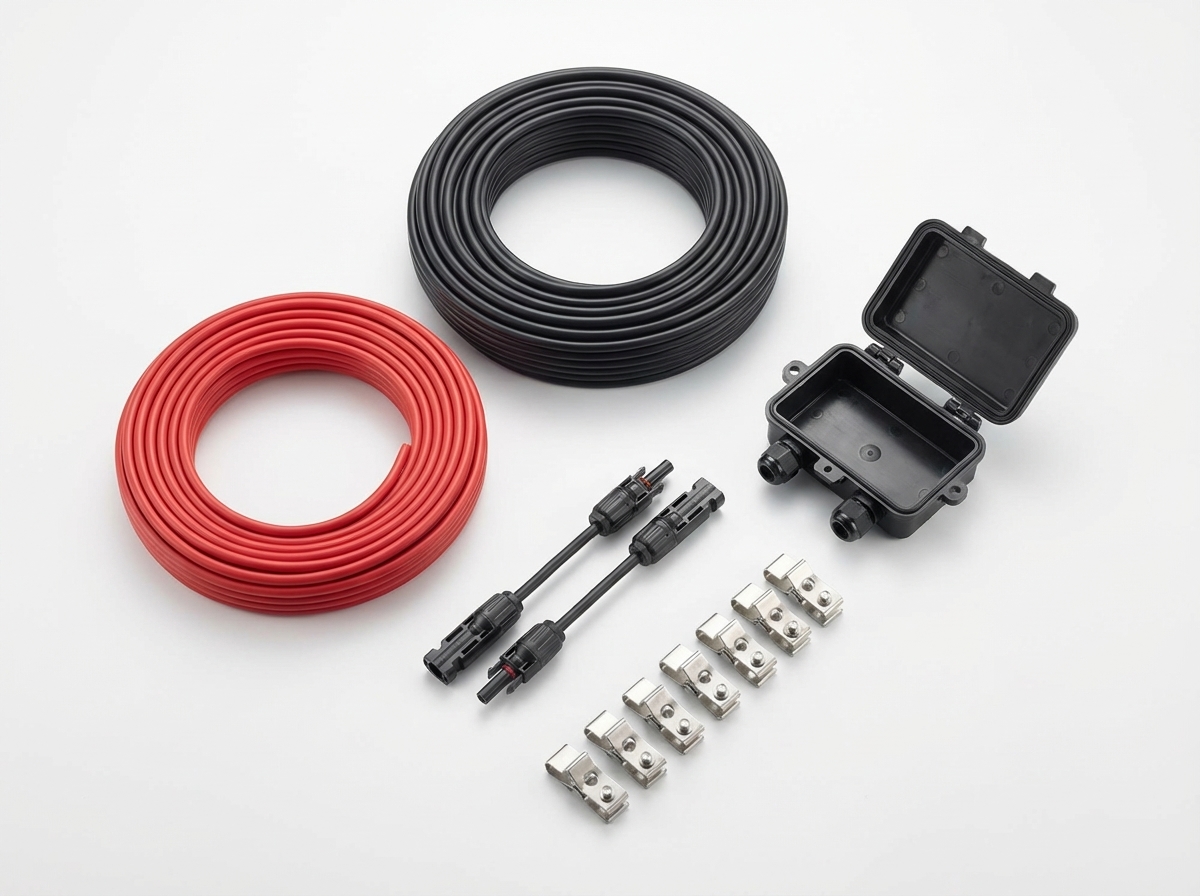
A solar combiner box consolidates the output of several PV strings into one feed before the inverter, and houses the string fuses, surge protection (SPD) and a DC disconnect that keep the array safe. It reduces the number of conductors running to the inverter and gives you one place to protect and inspect the DC side.
This guide explains what a combiner box does, how it differs from a junction box, when a project needs one, and how to choose and source it by string count and voltage class.
What a solar combiner box does
In a larger PV system, several strings are run in parallel and brought together at a combiner box. Inside, each string passes through its own fuse for over-current protection; a Type 2 (or Type 1+2) SPD protects against surges; and a DC disconnect or MCCB lets you isolate the combined output. The single combined feed then runs to the inverter, cutting conduit and wiring versus home-running every string.
Combiner box vs junction box — what people mean
The terms overlap. A panel "junction box" is the small sealed box on the back of a module with the bypass diodes. A field "junction box" or "combiner box" is the enclosure that combines strings with protection. When buyers search for a solar junction box for a system (not a panel), they usually mean a string combiner. If your design has multiple parallel strings to protect and combine, it is a combiner box you need.
When do you need a combiner box?
As a rule of thumb you need a combiner box once you have more than two parallel strings, or whenever string fusing, surge protection and a single DC disconnect are required by code or by the inverter design. Small one or two-string systems can often be wired direct; commercial and utility arrays almost always combine, because it is the code-compliant, inspectable way to manage many strings.
How to choose a combiner box (by string count and voltage)
Specify the inputs and outputs, the voltage class, and the protection you need inside the enclosure.
- String count: 2, 3, 4, 6, 8, 12 or 16-in / 1-out are the common configurations
- Voltage class: 1000V DC for most C&I, 1500V DC for utility blocks
- Inside: string fuse rating, SPD type (2 or 1+2), and DC MCCB or isolator on the output
- Enclosure: IP65/IP66, material and cable-gland layout for the install environment
- Monitoring: optional string-current monitoring for larger or remote arrays
What the export records actually show
We analysed 785 combiner box export records from Chinese suppliers covering 383 buyers between January 2025 and July 2026. Two patterns are worth knowing before you specify. First, only 57 of those records state 1000V and 13 state 1500V — roughly nine in ten shipment descriptions carry no voltage class at all, which is the same gap that lets 1000V-rated internals end up in a box destined for a 1500V array. Second, eight of the twelve most active buyers ran two to four suppliers in parallel over that period, so cross-supplier comparison is the norm rather than the exception.
Method note: the dataset only covers shipments described as "combiner box"; equipment described as "array box" or "string box" is not included, so utility-scale units are likely under-represented. Full analysis is in our combiner box procurement data study.
Sourcing combiner boxes in bulk
A combiner box is an assembled product, so the value is in the component brands and the build quality, not just the enclosure. For project or distributor volumes, confirm the internal BOM and a wiring diagram before the order.
- String count, voltage class and in/out configuration
- Component list: fuse, SPD, isolator/MCCB brands and ratings
- Enclosure IP rating, material and gland layout
- Monitoring requirement and certificate set
- Wiring diagram and a sample or factory photos before bulk
Solar combiner box selection by system
| System | Typical config | Voltage | Inside |
|---|---|---|---|
| Small C&I rooftop | 4-in / 1-out | 1000V DC | String fuses, Type 2 SPD, DC isolator |
| Medium C&I | 8–12-in / 1-out | 1000V DC | Fuses, SPD, DC MCCB, optional monitoring |
| Utility block | 12–16-in / 1-out | 1500V DC | 1500V fuses, Type 1+2 SPD, MCCB, monitoring |
OmniSol builds combiner boxes to your string count, voltage class and internal BOM from audited partner factories, with the wiring diagram and component list confirmed at the RFQ stage.
Procurement decision table
| Decision area | Buyer question | Procurement check | Risk control |
|---|---|---|---|
| Product scope | Which product families does this cover? | Solar Combiner Boxes (all), 8-String Combiner Box, 1500V DC Combiner Box | Buying on enclosure alone without the internal component list |
| Specification input | What must be stated before comparing quotes? | String count and in/out configuration | Use the same specification wording across supplier quotes. |
| Commercial input | What makes the quote operationally useful? | 1000V or 1500V DC voltage class | Tie quantity, packing and destination to the same RFQ line. |
| Quality gate | What should be checked before shipment? | Combiner Box Configurator | Mixing voltage classes (1000V parts in a 1500V box) |
BOM and RFQ context
Solar Combiner Box: What It Is, When You Need One & How to Choose is most useful when it is read as a sourcing decision, not only an informational article. The affected product scope normally includes Solar Combiner Boxes (all), 8-String Combiner Box, 1500V DC Combiner Box. A buyer should connect the answer to a live BOM, because cable size, connector rating, protection device choice, box configuration, storage accessories and export packing can change together.
For a procurement guide, the goal is to turn a broad buying question into a repeatable RFQ structure. The buyer should leave with the required product family, specification fields, quality checks and internal links needed to continue into the central products hub. In an RFQ, the minimum inputs should include String count and in/out configuration, 1000V or 1500V DC voltage class, String fuse rating and SPD type, Output DC MCCB or isolator. These inputs let a sourcing team compare suppliers on the same basis instead of only comparing unit price.
The related follow-up content is Combiner Box Configurator, PV Combiner Box Wiring Guide, DC Protection Selection Guide. Use those pages to validate standards, sizing, inspection and packing before sending a final quote request. The main risk to avoid is: Buying on enclosure alone without the internal component list Mixing voltage classes (1000V parts in a 1500V box)
FAQ
What is a solar combiner box?
A solar combiner box is an enclosure that combines the output of several PV strings into one feed before the inverter, and houses the string fuses, surge protection (SPD) and a DC disconnect that protect the DC side. It reduces the number of conductors to the inverter and gives one place to protect and inspect the array.
Do I need a combiner box for my solar system?
Generally yes once you have more than two parallel strings, or when string fusing, surge protection and a single DC disconnect are required by code or the inverter design. One or two-string systems can often be wired directly, but commercial and utility arrays almost always use a combiner box.
What is the difference between a combiner box and a junction box?
A panel junction box is the small sealed box on the back of a module containing the bypass diodes. A combiner (field junction) box is the enclosure that combines several strings and houses the protection. Buyers searching for a solar junction box for a system usually mean a string combiner box.
How many strings can a combiner box take?
Common configurations are 2, 3, 4, 6, 8, 12 and 16 strings in to one output. Choose the input count for your array, the 1000V or 1500V DC voltage class, and the string fuse and SPD ratings to match.
Can I source solar combiner boxes in bulk from China?
Yes. Because a combiner box is an assembled product, confirm the internal BOM (fuse, SPD and isolator/MCCB brands and ratings), the IP rating, the wiring diagram and a sample or factory photos before the bulk order. OmniSol builds combiner boxes to your specification from audited partner factories.