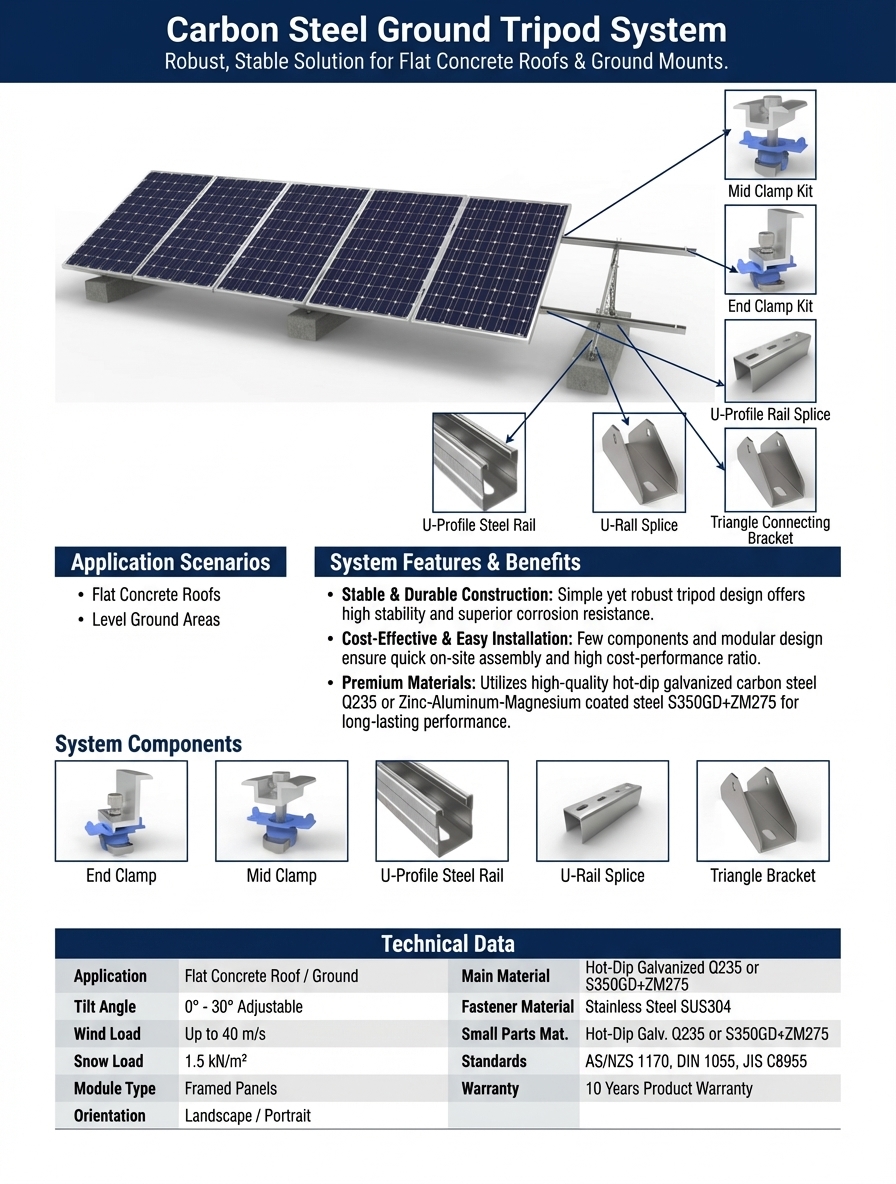
Carbon Steel Ballast System
RFQ inputs
Quantity, destination, certificate needs.
QC proof
Inspection and document review before shipping.
Export ready
Packaging and mixed-container planning.
Procurement Snapshot
Commercial details are confirmed by SKU, quantity and destination at RFQ stage.
RFQ checklist
Send these points with your inquiry for faster pricing.
Documents to confirm
Often sourced together
Technical Data
Specification values for buyer review and RFQ matching
| Material | Q235B Carbon Steel |
|---|---|
| Coating | Hot-Dip Galvanized (Avg 80μm) |
| Foundation | Concrete Blocks (Ballast) |
| Tilt Angle | 10° / 15° / Custom |
| Wind Load | 45 m/s (Ballast weight dependent) |
| Snow Load | 1.6 kN/m² |
| Service Life | 25 Years |
Procurement & BOM Notes
How Carbon Steel Ballast System is sourced
OmniSol sources Carbon Steel Ballast System factory-direct as part of the Roof Mounting family, quoted against your project quantity, destination port and material (Q235B Carbon Steel). Pricing and lead time are confirmed by SKU and order size at the RFQ stage, and OmniSol can propose a current-equivalent option if the exact variant is unavailable, so the line stays on schedule.
BOM fit
Carbon Steel Ballast System is part of the structural BOM and is sized from the roof or ground layout and the wind and snow load. It consolidates with rails, clamps, fasteners and the rest of the project BOS into one freight-optimised container.
Certification check
Confirm the Carbon Steel Ballast System certificates — Steel: Q235B per GB/T 700 — mill certificate included, HDG coating: avg 80μm per GB/T 13912 and EN ISO 1461, Wind/snow structural calculation: AS/NZS 1170, ASCE 7-22, Eurocode EN 1991 — project report on request, 10-year material warranty; 25-year design service life — the material certificate and coating thickness for the destination before ordering. OmniSol supplies material and surface-treatment reports at RFQ.
Product Overview
Flat concrete commercial rooftops typically prohibit roof penetrations to protect the waterproofing membrane warranty. The Carbon Steel Ballast System provides a non-penetrating solar mounting solution that uses the weight of concrete blocks — rather than bolts through the roof — to resist wind uplift. The ballast calculation accounts for site wind speed, module tilt angle, and array configuration.
The system uses a split front-to-rear frame design: a front ballast leg supports the module lower edge while a rear cross-rail elevates the module upper edge to the specified tilt angle. Both components are fabricated from Q235B carbon steel and hot-dip galvanized to an average coating weight of 80μm, conforming to GB/T 13912 and EN ISO 1461.
An EPDM isolation pad is placed under each foot contact point to prevent direct metal-to-concrete contact, protecting the roof membrane from abrasion and preventing galvanic corrosion. The pad also provides vibration damping to reduce noise from wind-induced panel movement.
Standard tilt angles of 10° and 15° are available from stock; custom angles up to 30° can be specified for sites requiring energy yield optimization. OmniSol provides a project-specific ballast weight calculation for every order based on site wind speed (AS/NZS 1170.2, ASCE 7, or Eurocode as applicable).
Applications
Commercial flat concrete rooftops where roof penetrations are contractually prohibited
Supermarket, retail, and warehouse flat rooftop solar
Multi-storey car park rooftop solar installations
Institutional buildings (hospitals, schools) with active membrane roof warranties
Retrofit solar additions to existing commercial buildings
Installation Notes
Obtain a project-specific ballast weight calculation from OmniSol before installation — do not rely on generic ballast tables, as weight requirement varies significantly with wind speed, tilt angle, and distance from roof edge.
Place EPDM isolation pads (minimum 3mm thickness) under each ballast foot before setting the frame — check that pads cover the full foot contact area with no overhang or gaps.
Set the front-to-rear frame spacing to match the tilt bracket slot positions before loading with ballast blocks — frames are difficult to reposition once loaded.
Maintain a minimum 600mm setback from the roof parapet for standard tilt angles — arrays closer to the parapet require a revised wind load calculation and may need additional ballast.
Certifications & Compliance
Frequently Asked Questions
How is the required ballast weight determined?
OmniSol calculates ballast weight for every project using the applicable standard (AS/NZS 1170.2, ASCE 7-22, or Eurocode EN 1991-1-4) based on site-specific wind speed, building height, terrain category, array layout, tilt angle, and distance from parapet. Provide the site address and wind speed reference to receive a calculation.
Will the ballast system void the roof waterproofing warranty?
Not if installed with EPDM isolation pads as specified. The pads prevent direct contact between the steel feet and the membrane. Check with your membrane supplier before installation if the warranty is critical.
What concrete block dimensions are recommended?
Standard 400×400×100mm paving slabs (approx 40kg each) are widely used. The quantity per frame is specified in the project ballast calculation. OmniSol can supply a standard block specification drawing if required.
Can the system be used on PVC or TPO single-ply membrane roofs?
Yes — with appropriate protection layers. A walkway pad or additional EPDM protection mat is recommended under high-contact-pressure points on soft single-ply membranes.
What are the standard module tilt angles?
10° and 15° are standard production angles. Custom angles from 5° to 30° are available on request with lead time adjustment.
Technical Guides
Products & Systems
Markets & Services
Need project-specific engineering support?
Free CAD layout, wind/snow load calculations, and BOM review included with project orders.
Related Products
More components from the same application category.
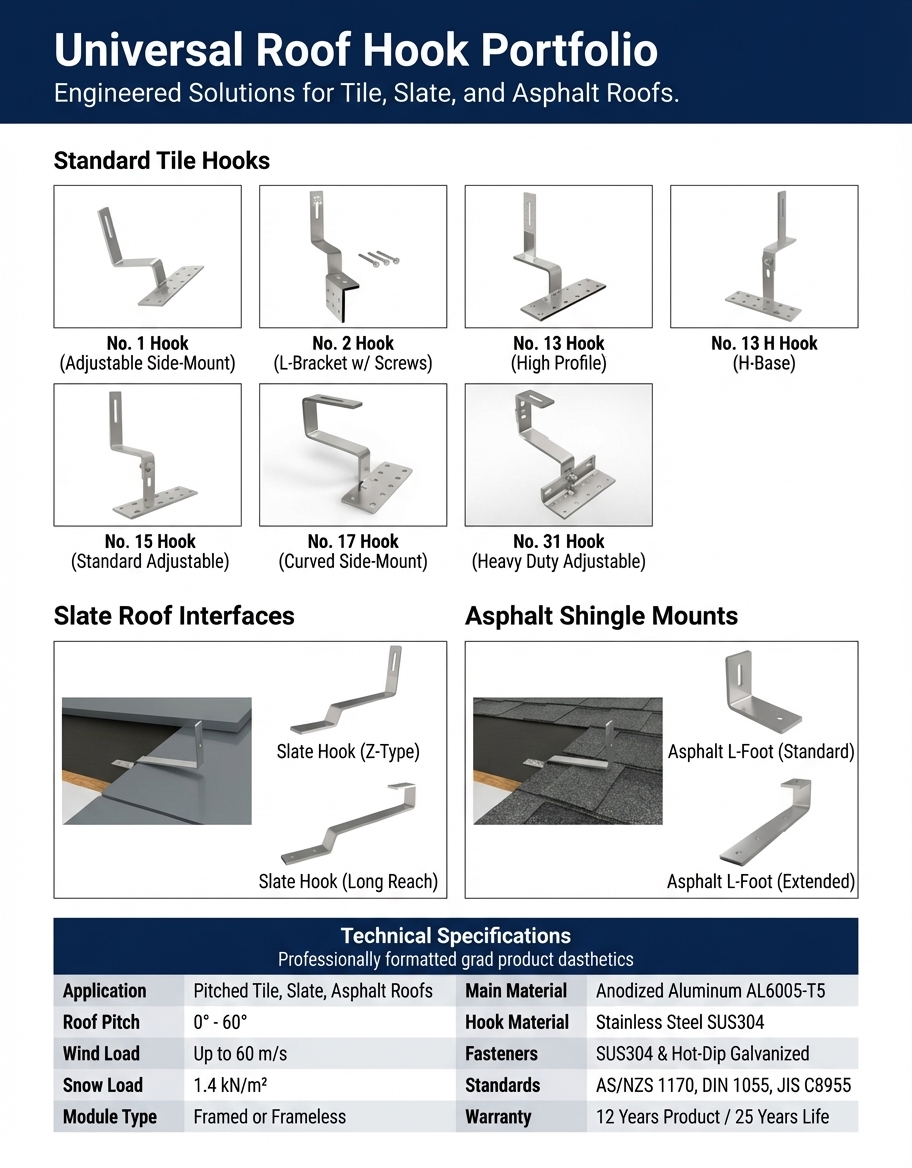
Universal Tile Hook System
Our flagship tile roof solution featuring the OS-TH-01 Double Adjustable Hook. Compatible with Panti...
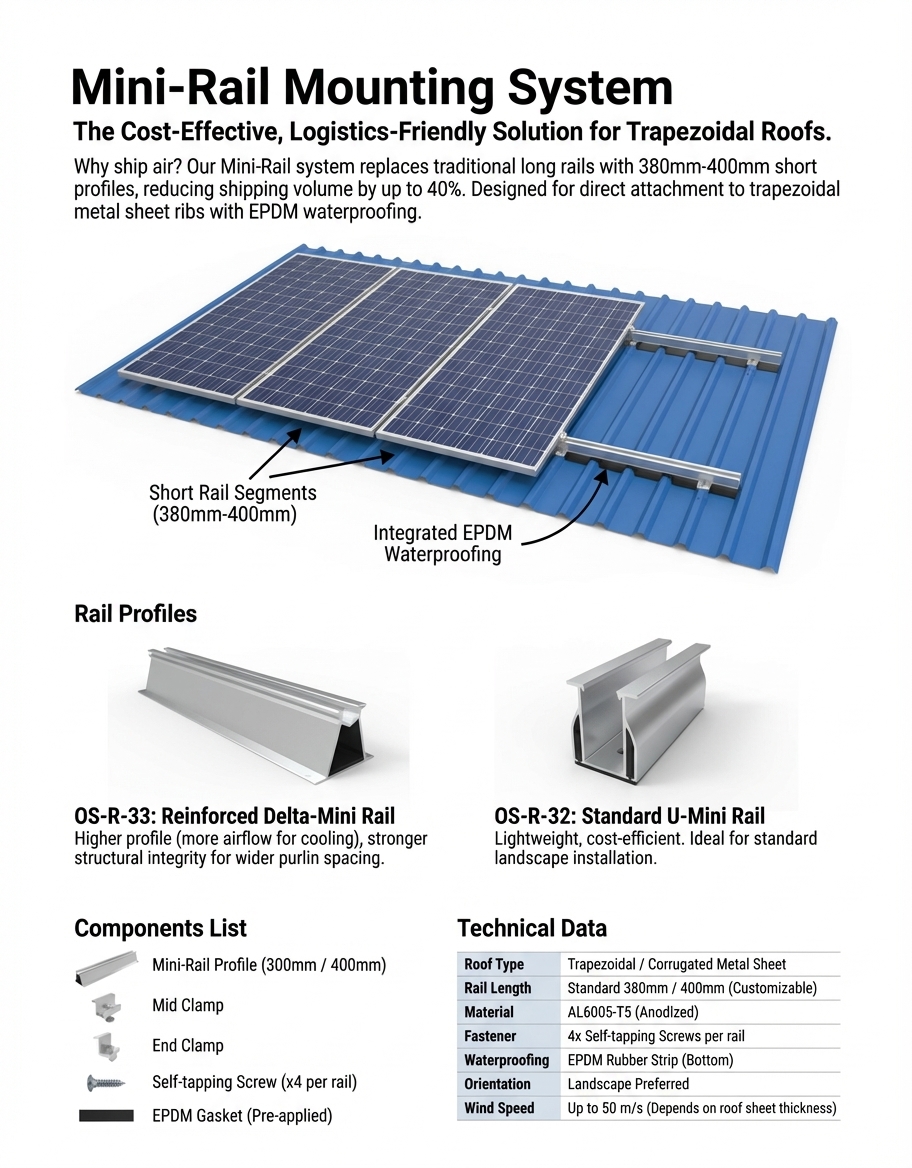
Trapezoidal Mini-Rail System
The ultimate cost-saver for trapezoidal metal roofs. By replacing long rails with 385mm short segmen...
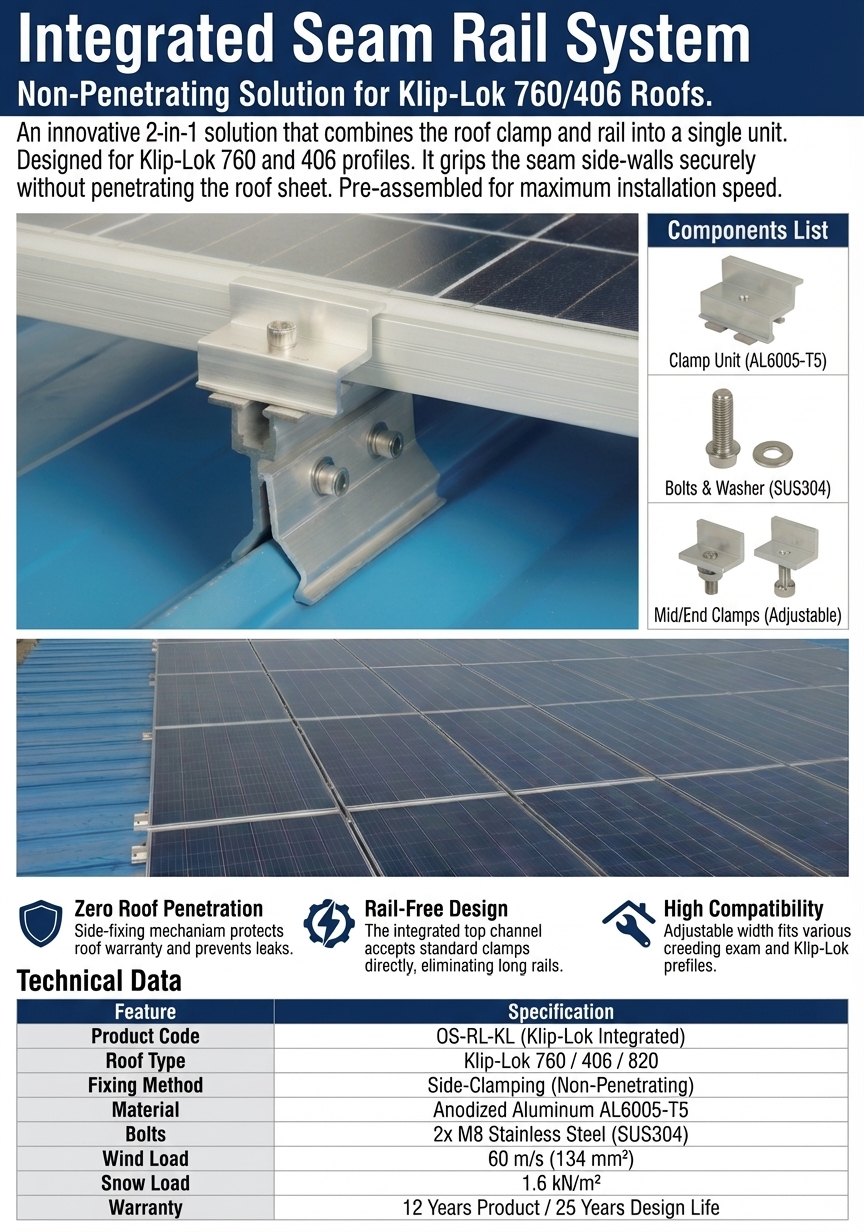
Integrated Seam Rail System
An innovative 2-in-1 solution that combines the roof clamp and rail into a single unit. Designed for...