What size solar pump do I need?
Choose a pump that meets your required flow at your total dynamic head. Horsepower, borehole depth and catalogue maxima cannot select that pump on their own.
Daily water delivery also depends on the seasonal solar resource, the array and controller, the water source and the operating schedule.
Updated
The inputs that determine the selection
| Input | Record this |
|---|---|
| Daily demand | Required cubic metres per day, peak season and acceptable interruptions. |
| Pumping water level | Measured drawdown at the intended abstraction rate, including seasonal variation. |
| Delivery point | Tank water elevation or required outlet pressure, referenced to the same datum. |
| Pipework | Actual internal diameter, lengths, fittings and friction at the proposed flow. |
| Water source | Sustainable yield, bore diameter, sand, water chemistry and installation constraints. |
| Energy and storage | Location, design month, shading, array configuration, tank capacity and any backup supply. |
A worked example, not a product performance claim
| Assumed condition | Calculation or result |
|---|---|
| Static water level 45 m below wellhead; drawdown 10 m | Pumping water level: 55 m below wellhead. |
| Open tank water level 8 m above wellhead; assumed friction 5 m | Illustrative total dynamic head: 45 + 10 + 8 + 5 = 68 m. Friction must be recalculated at the selected flow. |
| 20 cubic metres in an assumed five-hour constant-flow window | Required average delivery during that window: 20 / 5 = 4 cubic metres per hour. |
| Preliminary duty requirement | 4 cubic metres per hour at 68 m. This is a requirement to validate, not proof that a particular motor or array meets it. |
Peak sun hours describe solar energy, not guaranteed hours at rated pump flow. Validate daily delivery using the proposed system and the local design-month conditions.
Why there is no horsepower-to-output table here
The previous tables used straight-line estimates between catalogue endpoints. Those estimates are not reliable model evidence and have been withdrawn. A power class cannot stand in for an identifiable pump curve.
Same power, different catalogue endpoints
These source-checked examples explain why power alone is insufficient. They do not predict flow at a selected head. Model curves and site-specific evidence are still required.
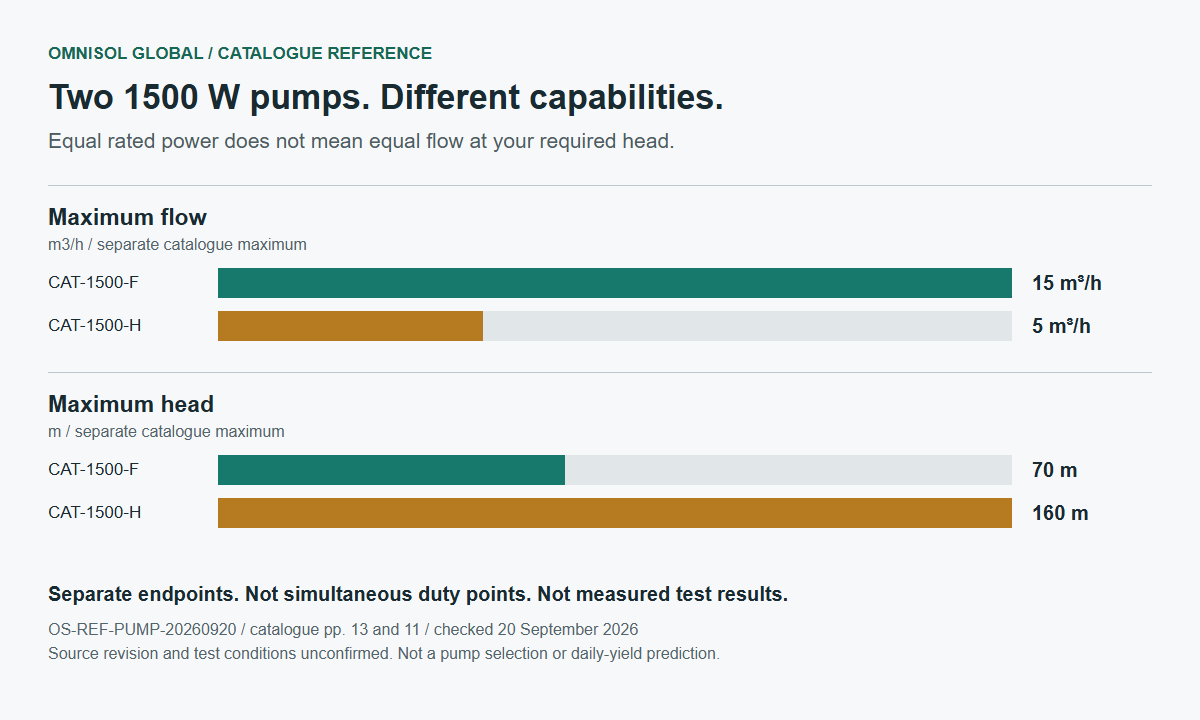
| Power / type | Reference | Maximum flow (separate endpoint) | Maximum head (separate endpoint) |
|---|---|---|---|
| 750 W1 HP / DC; centrifugal / screw examples | CAT-0750-FCatalogue p. 13 | 10 m³/h | 50 m |
| 750 W1 HP / DC; centrifugal / screw examples | CAT-0750-HCatalogue p. 3 | 2 m³/h | 120 m |
| 1100 W1.5 HP / DC submersible examples | CAT-1100-FCatalogue p. 13 | 10 m³/h | 70 m |
| 1100 W1.5 HP / DC submersible examples | CAT-1100-HCatalogue p. 11 | 4.5 m³/h | 110 m |
| 1300 W1.75 HP / DC submersible examples | CAT-1300-FCatalogue p. 13 | 13 m³/h | 60 m |
| 1300 W1.75 HP / DC submersible examples | CAT-1300-HCatalogue p. 11 | 5.5 m³/h | 128 m |
| 1500 W2 HP / DC submersible examples | CAT-1500-FCatalogue p. 13 | 15 m³/h | 70 m |
| 1500 W2 HP / DC submersible examples | CAT-1500-HCatalogue p. 11 | 5 m³/h | 160 m |
| 2200 W3 HP / AC/DC hybrid submersible examples | CAT-2200-FCatalogue p. 26 | 22 m³/h | 62 m |
| 2200 W3 HP / AC/DC hybrid submersible examples | CAT-2200-HCatalogue p. 23 | 9 m³/h | 158 m |
Evidence register: OS-REF-PUMP-20260920. Transcriptions checked on . Reference IDs identify individual source records, not OmniSol product models. Request the model mapping and applicable documentation with your enquiry. Catalogue revision and test conditions are not confirmed; these are not independently tested results or a selection recommendation.
Evidence to request with the quotation
| Evidence | Acceptance question |
|---|---|
| Exact model and hydraulic configuration | Do the curve, motor, impeller or stage configuration and quoted equipment match? |
| Curve document and revision | Are the document reference, issue date, speed and test conditions identified? |
| Marked duty point | Does the operating range include the required flow and head, with efficiency and power checked? |
| Daily yield assessment | Are the solar dataset, design month, array losses, controller limits and water-level assumptions stated? |
| Site acceptance plan | Who measures flow, head and operating conditions, and how will deviations be resolved? |
Technical background: Hydraulic Institute: pump curves.
Start with the site data
Send your daily demand and water-source measurements. Ask for the proposed model, documented curve and scope of supply before agreeing a selection.
Solar pump sizing questions
What size solar pump do I need for a 100 m borehole?
Drilled depth alone cannot select a pump. Record the pumping water level, outlet elevation, required pressure, pipe losses and daily water demand. Select an exact model against the resulting flow and total dynamic head, while checking bore diameter and water quality.
What size solar pump do I need for 20 cubic metres per day?
First estimate the pumping schedule for the design month. If an assumed five-hour delivery window were maintained at constant flow, 20 cubic metres would require 4 cubic metres per hour. This arithmetic is not a solar yield prediction or a motor size recommendation. The model curve, total dynamic head and time-varying solar input still need checking.
How much water can a 1.5 HP solar pump deliver per day?
Horsepower alone does not determine water output. Different hydraulic designs at the same motor rating have different flow-head curves. Request the exact model curve and a site-specific daily yield calculation for the design month; do not multiply a catalogue maximum by generic sun hours.
Is borehole depth the same as head?
No. For an open tank, total dynamic head includes the lift from the pumping water level to the tank water level and pipe and fitting losses. A pressurised outlet also adds the required pressure head. Drilled depth is relevant to installation but is not the pumping water level.
Can maximum flow and maximum head be used to calculate my output?
No. Two catalogue endpoints do not define the intervening curve. Do not draw a straight line between them to select or reject a model. Obtain a documented curve for the exact hydraulic configuration and speed, with your duty point marked.
Technical Guides
Products & Systems
Markets & Services
Need project-specific engineering support?
Free CAD layout, wind/snow load calculations, and BOM review included with project orders.