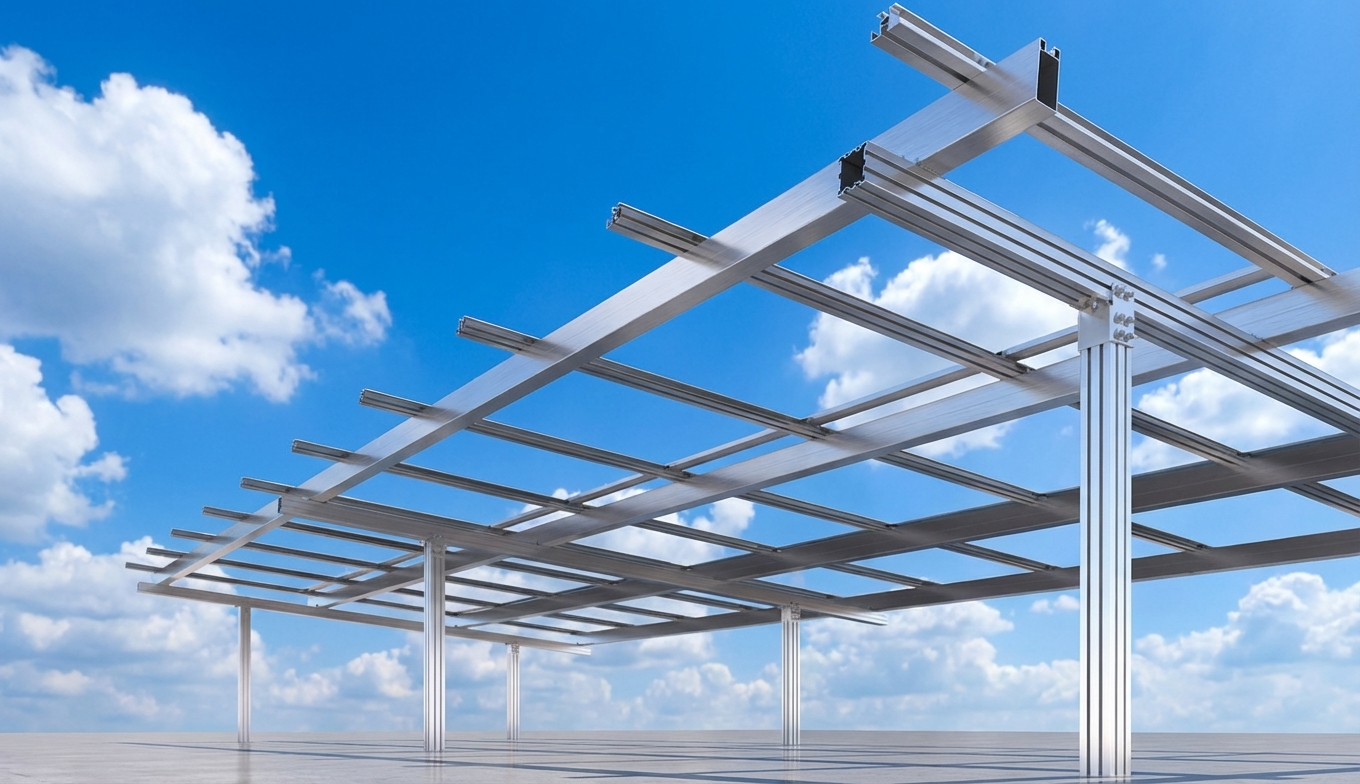
Waterproof BIPV Carport System
Why Quality Matters?
Solves the leakage issue of traditional solar carports. Our patented gutter rails catch water from panel gaps, protecting vehicles from acid rain and sun damage.
Layout:
Color:
RFQ inputs
Quantity, destination, certificate needs.
QC proof
Inspection and document review before shipping.
Export ready
Packaging and mixed-container planning.
Procurement Snapshot
Commercial details are confirmed by SKU, quantity and destination at RFQ stage.
RFQ checklist
Send these points with your inquiry for faster pricing.
Documents to confirm
Often sourced together
Technical Data
Specification values for buyer review and RFQ matching
| Waterproofing | Structural Gutter (No Sealant Needed) |
|---|---|
| Material | Anodized Aluminum AL6005-T5 |
| Wind Load | Up to 45 m/s (Customizable to 60m/s) |
| Snow Load | 1.6 kN/m² |
| Clearance Height | 2.5m (Min) - 4.5m (Max) |
| Foundation | Concrete Bolted / Embedded |
| Warranty | 15 Years Structure |
Procurement & BOM Notes
How Waterproof BIPV Carport System is sourced
OmniSol sources Waterproof BIPV Carport System factory-direct as part of the Carports family, quoted against your project quantity, destination port and waterproofing (Structural Gutter (No Sealant Needed)). Pricing and lead time are confirmed by SKU and order size at the RFQ stage, and OmniSol can propose a current-equivalent option if the exact variant is unavailable, so the line stays on schedule.
BOM fit
Waterproof BIPV Carport System is part of the structural BOM and is sized from the roof or ground layout and the wind and snow load. It consolidates with rails, clamps, fasteners and the rest of the project BOS into one freight-optimised container.
Certification check
Confirm the Waterproof BIPV Carport System certificates — EN AW-6005A T5 aluminum (EN 755-2) — mill certificate on request, Anodizing: EN ISO 7599, minimum 15μm thickness, Structural load calculation: EN 1990 / AS/NZS 1170 / ASCE 7-22 — project report included, CE Declaration of Performance (EU CPR) — structural components for European market, 15-year structural warranty — the material certificate and coating thickness for the destination before ordering. OmniSol supplies material and surface-treatment reports at RFQ.
Product Overview
A conventional solar carport — a structural frame with solar panels bolted to the top — has a fundamental waterproofing problem. Water enters through the bolt holes in the panel frames, accumulates between the panels, and drips onto vehicles below. The industry standard response has been to seal these gaps with silicone, but silicone degrades within 3–5 years under UV exposure and requires periodic maintenance.
OmniSol's waterproof carport system eliminates this problem through a structural change: the top beam is an extruded aluminum profile with an integrated W-shaped drainage channel. Water from the module surface flows across the panel face, into the inter-panel gap, and directly into the W-Drain channel in the beam — then travels along the beam to a downpipe at the column base. No sealant is in the primary drainage path; the extrusion geometry is the waterproofing.
The structural frame is made from EN AW-6005A T5 aluminum, anodized to a minimum 15μm thickness per EN ISO 7599. The anodized layer provides corrosion protection suitable for both inland and coastal environments within 500m of the shoreline. Powder coat finishes in standard RAL colors are available on request for architectural applications.
Column spacing of 5.5–6m standard allows single-bay (1-car) or double-bay (2-car) configurations. The top beam section depth is sized for the span, with increased section depth available for spans up to 8m between columns. Foundation options include driven steel H-pile, cast concrete footing, and surface-mount ballast base for existing hardstand installations.
Applications
Commercial car park canopy structures with EV charging infrastructure
Supermarket and retail center parking lots
Factory and warehouse employee parking areas
Educational institution car parks — schools, universities, hospitals
Agricultural shade structures and farm vehicle parking
Installation Notes
Column base plates must be connected to a foundation designed by a structural engineer for the specific site wind zone and soil conditions — do not assume a standard foundation specification applies across different sites.
Install the W-Drain top beam with a minimum longitudinal slope of 2° (1:30) toward the column downpipe end — insufficient slope causes water pooling in the drainage channel during low-intensity rainfall.
Torque all M10 column-to-beam connection bolts to 40 N·m before raising the top beam section — do not leave the connection partially torqued under load.
EV charging conduit pathway requirements must be specified at order stage — the column extrusion includes integrated conduit slot provisions that cannot be easily added after fabrication.
Certifications & Compliance
Frequently Asked Questions
How does the W-Drain system work without sealant?
The top beam extrusion includes a built-in W-shaped drainage channel at the inter-panel gap position. Water that runs across the panel surface flows off the panel edge into the W-Drain channel, then travels along the beam gradient to a downpipe at the column base. The drainage path is entirely structural — no sealant is in the primary water flow path.
What foundation is required for the columns?
Driven steel H-pile (most common for soil sites), cast concrete spread footing, or surface-mount concrete ballast base (for existing hardstand). The foundation specification is prepared by OmniSol's engineering team for each project based on the site wind zone and ground conditions.
What module sizes are compatible?
Standard residential modules (1,722×1,134mm) through large commercial formats (up to 2,384×1,134mm). Custom inter-module spacing is adjustable at fabrication. Specify module dimensions at order.
Can the carport be used for EV charging stations?
Yes — column profiles include reserved conduit slots for cable management, and the beam can carry cable trays between columns. EV charger mounting provisions should be specified at order stage. Inverter and charger equipment is not included.
What are the available finish options?
Natural anodized (silver) is standard. Black anodized and custom RAL powder coat colors are available with minimum order quantities. Powder coat finishes require specification at order stage and add 2–3 weeks to lead time.
Technical Guides
Products & Systems
Markets & Services
Need project-specific engineering support?
Free CAD layout, wind/snow load calculations, and BOM review included with project orders.