Direct answer
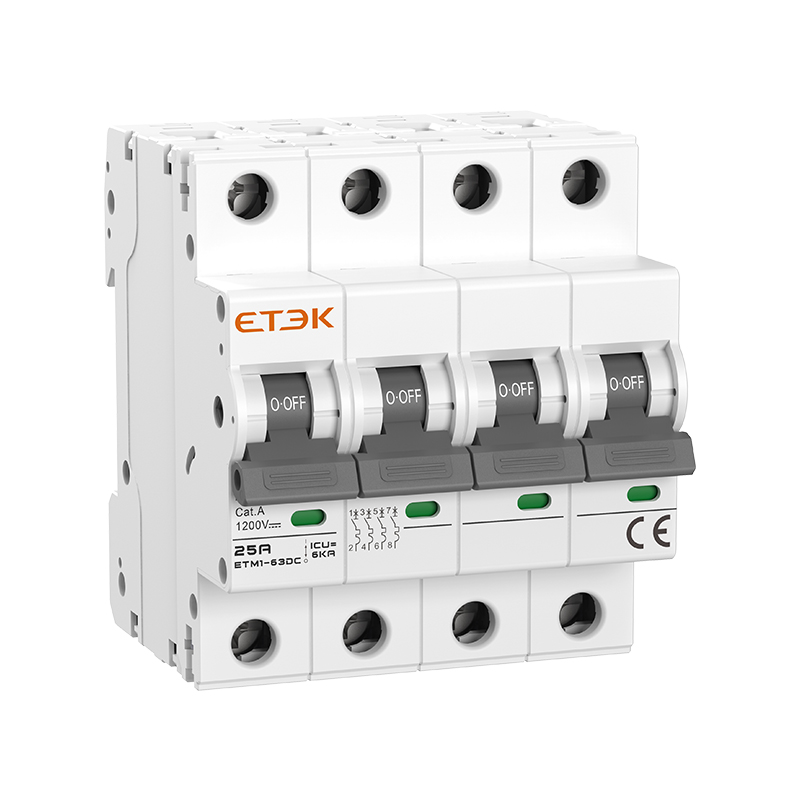
A solar DC circuit breaker protects DC circuits in PV systems against overcurrent and short-circuit faults. Unlike AC breakers, DC devices must handle sustained arc energy without a natural zero-crossing. Selection depends on five factors: (1) system voltage — 1000V or 1500V DC; (2) rated current — sized at 1.25× string Isc for string protection; (3) breaking capacity — must exceed the available fault current at the point of installation; (4) pole count — typically 2P for single string, 4P for dual-string or bipolar circuits; (5) use position — string breaker inside combiner box, combiner output breaker, or inverter-side DC feeder.
DC arc energy is continuous — a DC breaker must force the arc to extinction without a zero-crossing. Never substitute an AC MCB in a DC circuit, even if the voltage rating looks similar. Verify DC-rated interrupting capacity on the product nameplate.
Core procurement parameters
| String protection (1000V) | DC MCB 2P or 4P, 1000V DC, rated 1.25× string Isc (typically 10–16A for crystalline modules) |
|---|---|
| String protection (1500V) | DC MCB 2P or 4P, 1500V DC, same current sizing rule; verify terminal spacing for high-voltage clearance |
| Combiner output (small) | DC MCCB or heavy-duty MCB, 1000–1500V DC, 40–160A depending on string count and conductor size |
| Combiner output (large) | DC MCCB, 1500V DC, 160–400A frame; confirm breaking capacity against fault level at combiner terminals |
| Inverter DC input | Match inverter manufacturer specification; some inverters have internal protection — confirm with inverter datasheet before adding external breaker |
Applications
- PV string overcurrent protection inside combiner box
- Combiner box output feeder protection
- Inverter DC input disconnection
- DC distribution panels and busbars
Available options
- DC MCB (compact, DIN rail, up to ~63A)
- DC MCCB (higher frame, adjustable trip, 100A–630A)
- Pre-assembled inside combiner box
- Loose device supply with certificate
QC points before shipment
BOM procurement notes
DC Circuit Breaker for Solar PV should be treated as part of a procurement BOM, not as an isolated catalogue item. The usual starting points are string protection (1000v) (DC MCB 2P or 4P, 1000V DC, rated 1.25× string Isc (typically 10–16A for crystalline modules)), string protection (1500v) (DC MCB 2P or 4P, 1500V DC, same current sizing rule; verify terminal spacing for high-voltage clearance), combiner output (small) (DC MCCB or heavy-duty MCB, 1000–1500V DC, 40–160A depending on string count and conductor size). Typical use cases include PV string overcurrent protection inside combiner box, Combiner box output feeder protection, Inverter DC input disconnection. DC protection items should be selected as one coordinated circuit path: string fuse or DC MCB, Type 2 SPD, isolator or MCCB, enclosure rating and the combiner or inverter interface. The correct device depends on voltage class, fault-current assumption, pole count and project layout.
A practical RFQ should describe the required variant, quantity and packing in the same language the site team will use later. For this page, the common option set includes DC MCB (compact, DIN rail, up to ~63A), DC MCCB (higher frame, adjustable trip, 100A–630A), Pre-assembled inside combiner box. The RFQ checklist should cover System voltage (1000V or 1500V DC), String Isc (to size at 1.25×), Fault level at installation point (for breaking capacity), Pole count so the quote can be compared across suppliers without hidden assumptions.
For protection pages, buyers should request datasheets, certificates, wiring diagrams, marking photos and packing labels before shipment. Small rating mistakes are expensive because protection devices are usually installed inside boxes that are already wired and labeled. Before shipment, the inspection record should include Verify DC voltage marking on nameplate (not just AC rating); Confirm interrupting capacity is DC-rated; Check pole count and terminal spacing. This gives EPC buyers and distributors a cleaner handover from sourcing to receiving, especially when the order is consolidated with other BOS lines from the central products hub.
FAQ
Can AC MCBs be used in solar DC circuits?
No. AC MCBs rely on a current zero-crossing to extinguish the arc. DC circuits have no zero-crossing, so an AC breaker may fail to interrupt a DC fault, causing sustained arcing and fire risk. Always use DC-rated devices with a DC interrupting capacity marked on the nameplate.
How do I size a string fuse or breaker?
Per IEC 60364-7-712, the minimum string protection rating is 1.25 × Isc of the module. The device rating must also not exceed the module's maximum series fuse rating from its datasheet. For example, a module with Isc = 10.5A requires a minimum device rating of 13.1A — select the next standard size (15A or 16A depending on device range).
Should I choose a DC MCB or DC MCCB?
DC MCBs are compact and cost-effective for string-level protection up to about 63A. DC MCCBs are used for combiner outputs and feeders where current is higher and adjustable trip settings or higher breaking capacity is needed. For currents above 63A or fault levels above the MCB's breaking capacity, specify a MCCB.
What breaking capacity is needed for a combiner box output breaker?
The minimum breaking capacity must exceed the available fault current at the combiner output terminals. This depends on cable impedance and the sum of all string currents flowing into the bus. A conservative approach is to calculate the maximum prospective fault current and add 25% margin, then select the next standard device breaking capacity.
What certificates should I request?
For most markets: IEC 60947-2 (for MCCB) or IEC 60898 / IEC 60947-2 (for MCB), with explicit DC voltage class on the test report. For EU: CE Declaration of Conformity. For AU/NZ: RCM mark or SAA acceptance. For USA: UL 489B listing required for grid-connected systems — confirm with AHJ.