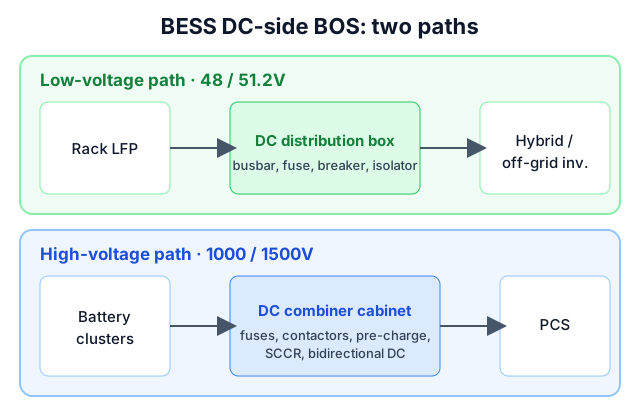
Balance-of-system on the DC side of a battery is everything between the battery terminals and the power conversion or load: distribution, protection and interconnection. It is where fault current is managed, where the system is switched and isolated, and where many important protection, switching and compliance questions arise. Other questions live at the battery, PCS, thermal-management, fire and installation levels.
This page explains what BESS DC-side BOS includes, how PV and battery differ, and how the low-voltage and high-voltage paths diverge.
48/51.2V Low-Voltage Path
Rack LFP plus hybrid or off-grid inverter: high current, busbar and cable sizing, parallel batteries, terminal temperature rise. Send your system parameters and we will route the low-voltage inquiry.
Send low-voltage parameters1000/1500V High-Voltage Path
C&I and microgrid cluster BESS: prospective fault current, SCCR, contactors, pre-charge and the BMS/PCS interface. Send your single-line and BOM and we will route the high-voltage inquiry.
Send high-voltage parametersWhat is BESS DC-side BOS?
BESS DC-side BOS is the distribution boxes and cabinets, fuses, breakers, isolators, contactors, pre-charge circuits, shunts, busbars, harnesses and cable assemblies that sit between the battery and the PCS or load. It is the DC BOS layer, distinct from the cells, the power conversion and the thermal or fire systems.
How PV and battery DC differ
A PV array is a current-limited source whose output collapses in the dark. A battery is a low-impedance energy store that can deliver very high fault current regardless of sunlight and stays live until isolated. That difference drives different fuse, breaking-capacity, switching and disconnection requirements, covered in the BESS vs PV DC protection guide.
The low-voltage path (48 / 51.2V)
The low-voltage path pairs rack LFP batteries with a hybrid or off-grid inverter. The engineering problems are high current, busbar and cable sizing, multiple batteries in parallel, and terminal temperature rise. Typical buyers are small system integrators, installers, distributors and off-grid contractors.
The high-voltage path (1000 / 1500V)
The high-voltage path is cluster combining for C&I and microgrid BESS. The engineering problems are prospective fault current, breaking capacity and SCCR, bidirectional DC, contactors and pre-charge, and the BMS and PCS interface. Typical buyers are microgrid integrators, EPCs, C&I BESS integrators and DC-coupled retrofit projects.
Roles of the devices
A fuse is a one-shot fault-current interrupter; a breaker is a resettable overcurrent device; an isolator or load switch provides visible disconnection; a contactor is a controlled switch, often BMS-commanded; a pre-charge circuit limits inrush into a capacitive DC link; a shunt supports current sensing; busbars and harnesses carry and connect the DC current. Which of these a given system uses depends on voltage level and architecture.
The OmniSol capability boundary
OmniSol focuses on BESS DC-side distribution, protection and interconnection BOS, while coordinating batteries, inverters and integrated storage equipment through its existing sourcing network. Cell manufacturing, PCS power conversion, thermal-management integration and fire-suppression integration are outside the OmniSol self-operated product scope.
Product and certification documents are confirmed at the RFQ stage: component models, E-file references, ratings and conditions of use, together with the manufacturer of record, nameplate, warranty and QC responsibility for each project.
FAQ
What counts as BESS DC-side BOS?
Distribution and combiner enclosures and the DC protection, switching and interconnection between the battery and the PCS or load.
Do you handle the whole battery system?
OmniSol focuses on DC-side BOS and coordinates batteries, inverters and integrated storage through sourcing; cells, PCS, thermal and fire integration are outside self-operated scope.
48/51.2V or 1000/1500V, which path do I need?
Rack LFP with a hybrid or off-grid inverter uses the low-voltage path; a C&I cluster BESS uses the high-voltage cabinet path. Contact OmniSol with your system parameters and we will route the inquiry.