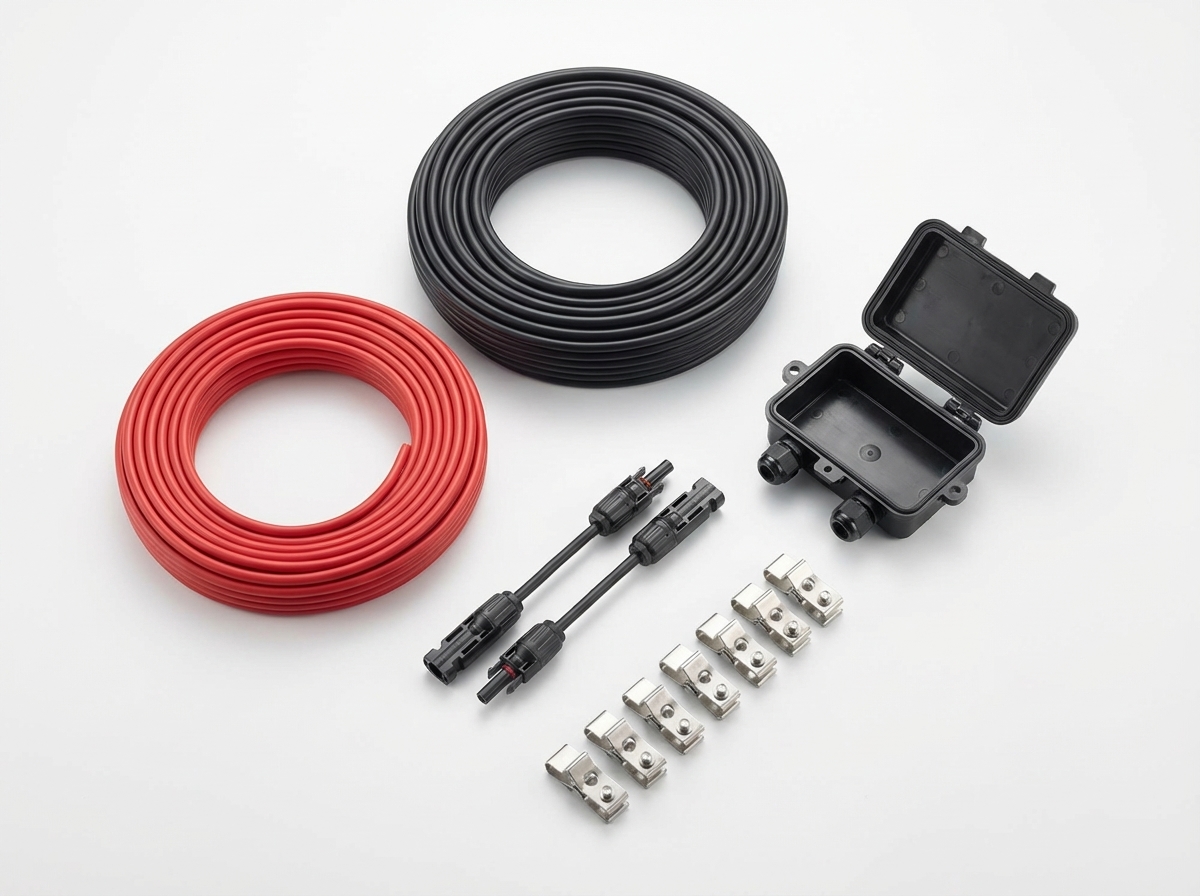
Bonding and grounding is where mounting BOMs most often fall short, and it is a frequent inspection failure: rails must be electrically bonded and the array grounded, but the small parts that do this are easy to leave off the order.
This checklist lists the bonding/grounding family so it is in the BOM from the start, not added by air freight after a failed inspection.
Bonding vs grounding
Bonding ties the metal parts together so they are at the same potential; grounding connects that bonded system to earth. Both are required. Rail splices and clamps may or may not be listed as bonding-rated, so confirm whether separate bonding jumpers are needed.
- WEEB clips or bonding-rated clamps between module and rail
- Grounding lugs at the rail/structure
- Bonding jumpers across rail splices and expansion joints
- Earth/grounding cable sized to local code
What inspectors check
Inspectors verify a continuous bonding path and a code-compliant ground, with listed components used as listed. Keep the component list, torque values and a wiring/grounding diagram with the order so the handover is clean.
Bonding & grounding BOM
| Component | Purpose | Spec to confirm |
|---|---|---|
| WEEB clip / bonding washer | Module-to-rail bond | Listed for the clamp/module combo |
| Grounding lug | Rail-to-EGC connection | Listed lug, correct conductor range |
| Bonding jumper | Across splices/joints | Length and lug to suit the rail |
| Earth cable | System ground | Cross-section per local code |
Confirm which clamps/splices are bonding-rated before adding separate jumpers. OmniSol includes the bonding/grounding line in the mounting BOM on request.
Procurement decision table
| Decision area | Buyer question | Procurement check | Risk control |
|---|---|---|---|
| Product scope | Which product families does this cover? | Solar Mounting Systems, DC Protection | Leaving bonding/grounding parts off the mounting BOM |
| Specification input | What must be stated before comparing quotes? | Module and clamp combination (for WEEB listing) | Use the same specification wording across supplier quotes. |
| Commercial input | What makes the quote operationally useful? | Rail type and number of splices | Tie quantity, packing and destination to the same RFQ line. |
| Quality gate | What should be checked before shipment? | Roof Solar Mounting Guide | Assuming all clamps/splices are bonding-rated |
BOM and RFQ context
Solar Rail Bonding & Grounding: BOM Checklist is most useful when it is read as a sourcing decision, not only an informational article. The affected product scope normally includes Solar Mounting Systems, DC Protection. A buyer should connect the answer to a live BOM, because cable size, connector rating, protection device choice, box configuration, storage accessories and export packing can change together.
For a procurement guide, the goal is to turn a broad buying question into a repeatable RFQ structure. The buyer should leave with the required product family, specification fields, quality checks and internal links needed to continue into the central products hub. In an RFQ, the minimum inputs should include Module and clamp combination (for WEEB listing), Rail type and number of splices, Local grounding code / standard, Earth conductor size required. These inputs let a sourcing team compare suppliers on the same basis instead of only comparing unit price.
The related follow-up content is Roof Solar Mounting Guide, Solar Mounting Standards Guide, BOS 1500V Selection Guide. Use those pages to validate standards, sizing, inspection and packing before sending a final quote request. The main risk to avoid is: Leaving bonding/grounding parts off the mounting BOM Assuming all clamps/splices are bonding-rated