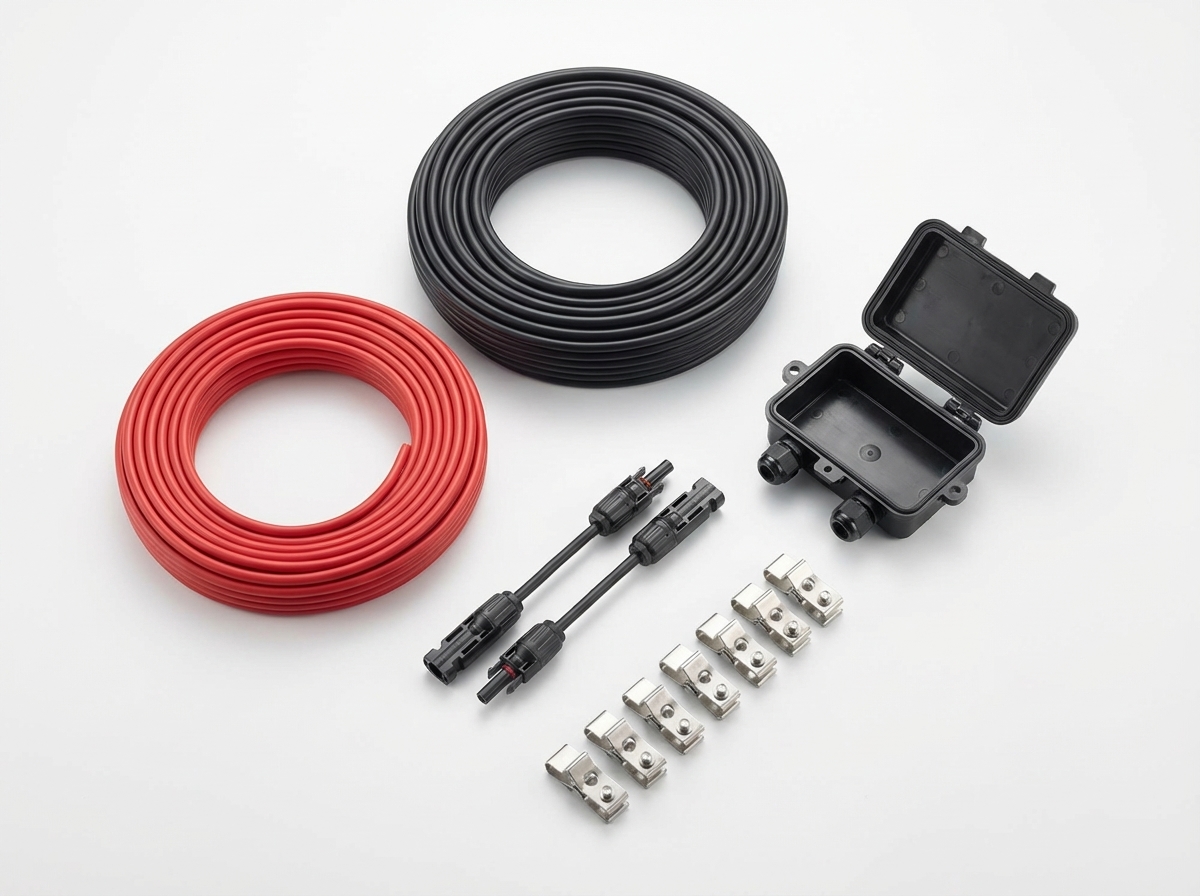
Cable and connectors are usually the line items with the loosest specification on a solar BOM — a length of "solar cable" and a bag of "MC4s". On an EPC project that vagueness is where field crimping errors, voltage-drop surprises and connector cross-mating show up. The cable and connectors are a matched DC link, and the BOM should describe them as one.
This breaks the cable-and-connector portion of the BOM into its line items, the rating to specify for each, and how the two sides have to agree (cable cross-section and connector cable-range must match).
The cable side: cross-section, length and standard
DC string cable is specified by cross-section (commonly 4mm², 6mm² or 10mm²), the conductor count and the cable standard — typically H1Z2Z2-K to EN 50618 / IEC 62930, rated to 1.5kV DC. The cross-section is a voltage-drop and ampacity decision, not a guess: longer runs and higher string current push you from 4mm² to 6mm². The BOM should state cross-section, total length per run (or drum quantity) and the standard, plus colour if positive/negative marking is required.
The connector side: types and quantities
Connectors are not one line. A string needs more than a pair of end connectors depending on the design.
- Standard pairs (male + female): the panel-to-cable and cable-to-cable joints
- Pre-crimped leads: where field crimping is to be avoided at volume
- Branch / Y connectors: to parallel a small number of matched strings
- Fuse connectors: inline string fusing where a combiner is not used
- Diode connectors: to block reverse current where the design requires it
Where the two sides must agree
The single most common cable/connector error is a connector whose cable-clamp range does not match the cable cross-section. An MC4-compatible connector is rated for a cable range (e.g. 4–6mm²); pairing it with 10mm² cable gives a loose, high-resistance crimp — a classic hot-joint cause. Specify the connector to the cable, and keep one connector brand and series within a string (cross-mating different brands is not a safe assumption).
Sourcing the cable + connector set together
Quoting cable and connectors from one matched BOM avoids the mismatch and the field crimping risk, and lets the drum lengths and connector quantities be reconciled before the order.
- Cable: cross-section, length/drums, standard, colour marking
- Connectors: type, quantity, and the cable range they must clamp
- Crimp tooling or pre-crimped leads decision
- One connector brand/series per string; certificate set
Cable + connector BOM line items
| Line item | Specify | Typical | Note |
|---|---|---|---|
| DC string cable | Cross-section, length, standard | 4 / 6 / 10mm² H1Z2Z2-K, 1.5kV DC | Cross-section follows voltage drop + ampacity |
| Connector pairs | Quantity, cable range | MC4-compatible, 4–6mm² | Must match the cable cross-section |
| Branch / Y connectors | Quantity, configuration | Y (2→1) matched strings only | Not a substitute for a combiner |
| Fuse connectors | Fuse rating, quantity | gPV inline | Where no combiner fuse is used |
| Crimp tooling / leads | Tool or pre-crimped | Pre-crimped at volume | Avoids field crimp errors |
OmniSol supplies the matched cable-and-connector set — cable to EN 50618 and connectors rated to the cable range — from audited partner factories, with pre-crimped leads available and the certificate set confirmed at the RFQ stage.
Procurement decision table
| Decision area | Buyer question | Procurement check | Risk control |
|---|---|---|---|
| Product scope | Which product families does this cover? | PV Cables, Connectors, DC Protection | Specifying "solar cable" with no cross-section or standard |
| Specification input | What must be stated before comparing quotes? | Cable cross-section (sized to voltage drop + ampacity) | Use the same specification wording across supplier quotes. |
| Commercial input | What makes the quote operationally useful? | Cable length / drum quantity and standard (EN 50618) | Tie quantity, packing and destination to the same RFQ line. |
| Quality gate | What should be checked before shipment? | Solar Cable & Wire Size Calculator | Connectors whose clamp range does not match the cable |
BOM and RFQ context
PV Cable & MC4 Connector BOM Structure: Line Items, Ratings & Quantities is most useful when it is read as a sourcing decision, not only an informational article. The affected product scope normally includes PV Cables, Connectors, DC Protection. A buyer should connect the answer to a live BOM, because cable size, connector rating, protection device choice, box configuration, storage accessories and export packing can change together.
For a procurement guide, the goal is to turn a broad buying question into a repeatable RFQ structure. The buyer should leave with the required product family, specification fields, quality checks and internal links needed to continue into the central products hub. In an RFQ, the minimum inputs should include Cable cross-section (sized to voltage drop + ampacity), Cable length / drum quantity and standard (EN 50618), Positive/negative colour marking if required, Connector types and quantities per string. These inputs let a sourcing team compare suppliers on the same basis instead of only comparing unit price.
The related follow-up content is Solar Cable & Wire Size Calculator, MC4 Connector Compatibility Guide, PV Cable Sizing & Voltage Drop Guide. Use those pages to validate standards, sizing, inspection and packing before sending a final quote request. The main risk to avoid is: Specifying "solar cable" with no cross-section or standard Connectors whose clamp range does not match the cable
FAQ
How is the cable and connector part of a solar BOM structured?
As a matched set: the DC string cable (cross-section, length, standard) and the connectors that terminate it (pairs, branch, fuse or diode connectors, with the cable range they clamp). The connector must match the cable cross-section, and one connector brand/series should be used within a string.
What cable cross-section do I specify — 4, 6 or 10mm²?
4mm² suits short residential string runs; 6mm² is common for longer runs, higher current or hot rooftops because of its lower resistance; 10mm² is used on long C&I/utility runs. The choice is a voltage-drop and ampacity calculation, not a default — size it to the run length and string current.
Can I mix MC4-compatible connectors from different brands in a string?
It is not a safe procurement assumption. Seal geometry, contact tolerance and certification scope differ by manufacturer, so keep one connector brand and series within each string unless the project engineer explicitly approves a combination.
Why do connector and cable cross-section have to match?
A connector is rated for a cable clamp range (e.g. 4–6mm²). Pairing it with a cable outside that range gives a loose, high-resistance crimp — a common cause of hot joints. Specify the connector to the cable, or use pre-crimped leads to remove field crimping error.