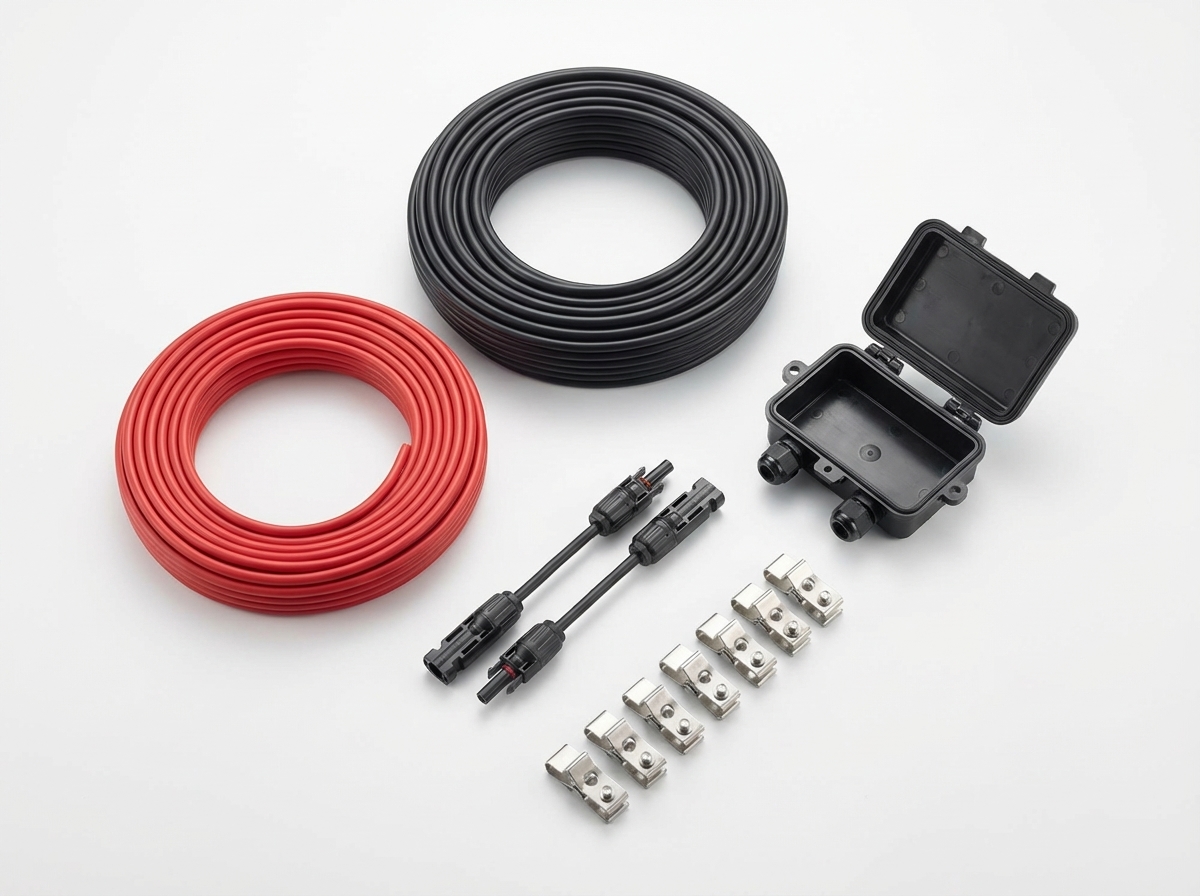
A complete solar project BOM typically spans five to eight product categories: PV cable, connectors, DC circuit breakers or fuses, surge protection devices, combiner boxes, AC protection, distribution boards and mounting hardware. Sourcing each category from a different Chinese supplier multiplies the logistics complexity — multiple factory audits, multiple packing lists, multiple customs entries, multiple quality checks — and typically increases total landed cost.
The alternative is a supplier who stocks or can source all BOS categories together and ships them in one consolidated container. One packing list, one quality inspection, one shipment, one supplier relationship. For small and medium buyers in particular, this is not just more convenient — it is often the only way direct China sourcing is economically viable.
What a complete solar BOS BOM covers
A full BOS BOM for a typical grid-connected solar project includes: PV DC cable (red and black or twin-core, in multiple cross-sections for string, home run and combiner output runs), MC4 or compatible connectors (branch connectors, inline connectors, end caps), DC protection (MCBs or fuses at string level, DC MCCB at combiner output), DC SPD at each combiner, combiner boxes (matched to the string count per inverter MPPT input), and AC protection (MCBs, RCCBs, SPD at the inverter output).
Mounting hardware — rails, clamps, hooks, brackets — rounds out the BOM for roof or ground projects. Energy storage accessories (battery cables, BMS interfaces, DC isolators) add to the list for storage-integrated projects. A single supplier covering all of these can produce one comprehensive quote and one shipment.
- PV DC cable: multiple cross-sections and colors
- Connectors: MC4 compatible, various configurations
- DC protection: string-level fuses or MCBs plus combiner output MCCB
- DC and AC SPDs: matched to system voltage and discharge class
- Combiner boxes: matched to string count and voltage class
- AC protection: inverter output MCB, RCCB, SPD
- Mounting hardware: rails, clamps, hooks, brackets
- Optional solar panels: wattage class, cell type, certification and warranty to be confirmed
Why single-supplier BOM sourcing changes the economics
Shipping cost is largely determined by container utilization, not by product count. A 20ft container that is half-full of cable and half-full of protection devices and combiner boxes costs the same to ship as a container of only cable. When you source all BOS categories from one supplier, you fill the container more efficiently and the per-unit shipping cost drops for every product.
Import administration is another significant cost. Each additional supplier in the supply chain adds a factory audit, a contract, a set of quality records, a separate pre-shipment inspection and potentially a separate customs entry. One supplier, one container, one entry simplifies everything. For buyers without a dedicated import team, this difference is substantial.
- Container utilization improves when multiple product categories are combined
- Per-unit shipping cost drops as container fill rate increases
- One factory audit and one quality inspection instead of several
- One packing list and one customs entry at the destination port
- Fewer supplier relationships to manage and maintain
How to prepare a full BOM for one-supplier sourcing
The starting point is a complete product list with ratings and quantities. For cable: conductor cross-section, insulation type (PV1-F, H1Z2Z2-K or PV wire), length in metres, and color. For connectors: type (single, branch, inline), current rating, quantity in pairs. For protection devices: rated voltage (1000V or 1500V DC), current rating, breaking capacity, number of poles, quantity.
You do not need to specify exact model numbers if you are not sure — specifying the technical requirements (voltage rating, current rating, certifications needed) is enough for the supplier to match the right product. A good supplier will confirm the specific model and data sheet before the order is placed.
- Cable: cross-section, insulation type, length, color
- Connectors: type, current rating, quantity in pairs
- DC protection: system voltage, rated current, breaking capacity, pole count
- Combiner boxes: string count, system voltage, SPD included or separate
- Mounting: roof type, rail system, panel count
- Certifications required: TÜV, UL, CE, AS/NZS, etc.
OmniSol's one-BOM approach
OmniSol stocks and sources across all major solar BOS categories — PV cable, connectors, DC and AC protection, combiner boxes, distribution boards, mounting hardware and energy storage accessories. A buyer who sends a full project BOM receives one quote covering all lines, one quality inspection process and one shipment.
For buyers placing their first mixed BOM order, OmniSol offers BOM review support — checking that the specified products are compatible, correctly rated and certified for the destination market. Missing items or incorrect ratings are caught at the quote stage, not on site.
- Solar panel plus BOS coverage across requested project categories in one quote
- BOM review before the order is confirmed
- One pre-shipment inspection for all product lines
- Consolidated shipping in one container
- Single point of contact for all product and logistics questions
Procurement decision table
| Decision area | Buyer question | Procurement check | Risk control |
|---|---|---|---|
| Product scope | Which product families does this cover? | PV Cables, Connectors, DC Protection | Sourcing cable, protection and combiner boxes from separate suppliers without coordinating shipping |
| Specification input | What must be stated before comparing quotes? | List solar panel requirements and all BOS categories required for the project | Use the same specification wording across supplier quotes. |
| Commercial input | What makes the quote operationally useful? | Specify ratings for each line (voltage, current, cross-section, etc.) | Tie quantity, packing and destination to the same RFQ line. |
| Quality gate | What should be checked before shipment? | Solar BOS Packing & Labeling Guide | Sending an incomplete BOM and expecting the supplier to fill in the gaps without guidance |
BOM and RFQ context
Sourcing a Complete Solar BOM from One Chinese Supplier is most useful when it is read as a sourcing decision, not only an informational article. The affected product scope normally includes PV Cables, Connectors, DC Protection, Combiner Boxes. A buyer should connect the answer to a live BOM, because cable size, connector rating, protection device choice, box configuration, storage accessories and export packing can change together.
For a procurement guide, the goal is to turn a broad buying question into a repeatable RFQ structure. The buyer should leave with the required product family, specification fields, quality checks and internal links needed to continue into the central products hub. In an RFQ, the minimum inputs should include List solar panel requirements and all BOS categories required for the project, Specify ratings for each line (voltage, current, cross-section, etc.), Include required certifications per product and per market, Note quantities for each line item. These inputs let a sourcing team compare suppliers on the same basis instead of only comparing unit price.
The related follow-up content is Solar BOS Packing & Labeling Guide, Solar BOS Inspection Checklist, Incoterms for Solar BOS Imports. Use those pages to validate standards, sizing, inspection and packing before sending a final quote request. The main risk to avoid is: Sourcing cable, protection and combiner boxes from separate suppliers without coordinating shipping Sending an incomplete BOM and expecting the supplier to fill in the gaps without guidance