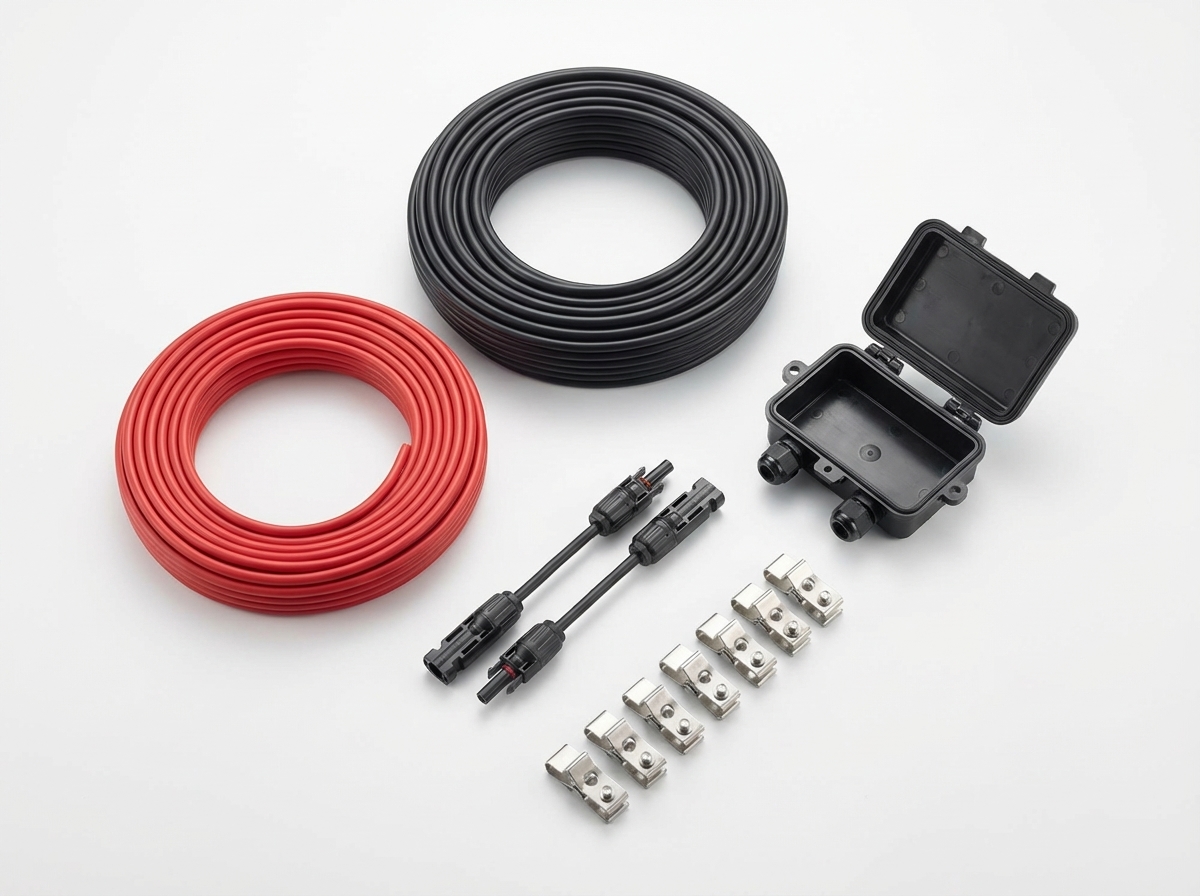
A solar project is not bought part by part — it is bought as a Balance of System (BOS): the family of components around the panels and inverter that make a working, compliant installation. Thinking in families is what keeps a BOM complete and lets the whole order ship in one container.
This page maps the BOS family structure end to end and links each family to its product hub, so a buyer can move from "what do I need" to a quote-ready BOM in one place.
What Balance of System actually includes
Balance of System covers everything in a PV installation beyond the modules: the structure that holds them, the wiring that connects them, the devices that protect them, the boxes that aggregate them, and — depending on the project — the inverter and storage that convert and store the energy. Grouping these into families is how EPCs and distributors avoid missing the small but essential items.
- Structure: mounting systems (roof, ground, carport, balcony)
- Conduction: PV cable and connectors
- Protection: DC protection, AC protection
- Aggregation: combiner boxes and distribution boards
- Conversion & storage: inverters, LiFePO4 batteries
- Completion: monitoring, grounding and accessories
How the families fit one BOM
The families connect in a fixed electrical order: modules sit on the mounting structure; PV cable and connectors carry the DC string current; DC protection and combiner boxes aggregate and protect the strings; the inverter converts to AC; AC protection and distribution feed the load or grid; storage and accessories complete the system. A complete BOM names every family with quantities, ratings and certificates so nothing is discovered missing on site.
Why source the whole family from one hub
When the families come from one sourcing hub, they can be matched on voltage class and rating, consolidated into one container, and inspected under one QC report and document set. That removes the cross-supplier coordination and the missing-accessory risk that comes with buying each family separately. Browse the families at the product hub and combine them into one BOM.
The solar BOS family hierarchy
| BOS family | What it covers | Role in the BOM |
|---|---|---|
| Mounting systems | Roof hooks, rails, clamps, ground & carport structures | Structural base — sized from wind/snow load |
| PV cable | H1Z2Z2-K, PV1-F, grounding cable | Carries DC from strings to combiner / inverter |
| Connectors | MC4-compatible pairs, branch & fused connectors | String interconnection |
| DC protection | gPV fuses, DC MCB/MCCB, SPD, isolators | Protects DC strings and combiner output |
| Combiner boxes | Configured 2- to 16-string DC assemblies | Aggregates strings to the inverter input |
| AC protection & distribution | MCB, RCBO, SPD, distribution boards | Protects inverter output and loads |
| Inverter & storage | Hybrid/off-grid inverters, LiFePO4 batteries | Conversion and backup |
| Accessories | Monitoring, grounding hardware, fittings | Completes and commissions the install |
Every family ships from one consolidated BOM. Browse each family at the product hub and combine them into a single container order.
Procurement decision table
| Decision area | Buyer question | Procurement check | Risk control |
|---|---|---|---|
| Product scope | Which product families does this cover? | All Solar BOS Products, Solar Mounting Systems, PV Cables | Quoting modules and inverter but omitting the BOS families |
| Specification input | What must be stated before comparing quotes? | Project size, voltage class (1000V/1500V) and phase type | Use the same specification wording across supplier quotes. |
| Commercial input | What makes the quote operationally useful? | Mounting type (roof/ground/carport) and structural loads | Tie quantity, packing and destination to the same RFQ line. |
| Quality gate | What should be checked before shipment? | How to Prepare a Quote-Ready Solar BOM | Leaving grounding, SPD or accessories off the BOM |
BOM and RFQ context
Solar BOS Product Family Structure: The Complete BOM System is most useful when it is read as a sourcing decision, not only an informational article. The affected product scope normally includes All Solar BOS Products, Solar Mounting Systems, PV Cables, Connectors. A buyer should connect the answer to a live BOM, because cable size, connector rating, protection device choice, box configuration, storage accessories and export packing can change together.
For a procurement guide, the goal is to turn a broad buying question into a repeatable RFQ structure. The buyer should leave with the required product family, specification fields, quality checks and internal links needed to continue into the central products hub. In an RFQ, the minimum inputs should include Project size, voltage class (1000V/1500V) and phase type, Mounting type (roof/ground/carport) and structural loads, Cable, connector and DC protection ratings, Combiner and AC distribution configuration. These inputs let a sourcing team compare suppliers on the same basis instead of only comparing unit price.
The related follow-up content is How to Prepare a Quote-Ready Solar BOM, Common Missing Items in EPC Solar BOMs, BOS 1500V Selection Guide. Use those pages to validate standards, sizing, inspection and packing before sending a final quote request. The main risk to avoid is: Quoting modules and inverter but omitting the BOS families Leaving grounding, SPD or accessories off the BOM
FAQ
What is BOS in a solar project?
Balance of System (BOS) is every component in a PV installation other than the panels — mounting, PV cable, connectors, DC and AC protection, combiner boxes, distribution boards, and (depending on scope) the inverter, storage and accessories. It is the family of parts that turns modules into a working, compliant system.
What product families are included in a solar BOS?
Mounting systems, PV cable, connectors, DC protection, combiner boxes, AC protection and distribution, inverter and storage, and accessories such as monitoring and grounding hardware. A complete BOM names each family with quantity, rating and certificate.
Can I source the whole BOS family from one supplier?
Yes. Sourcing all families from one hub lets them be matched on voltage and rating, consolidated into one container, and inspected under one QC report — which removes cross-supplier coordination and missing-accessory risk.