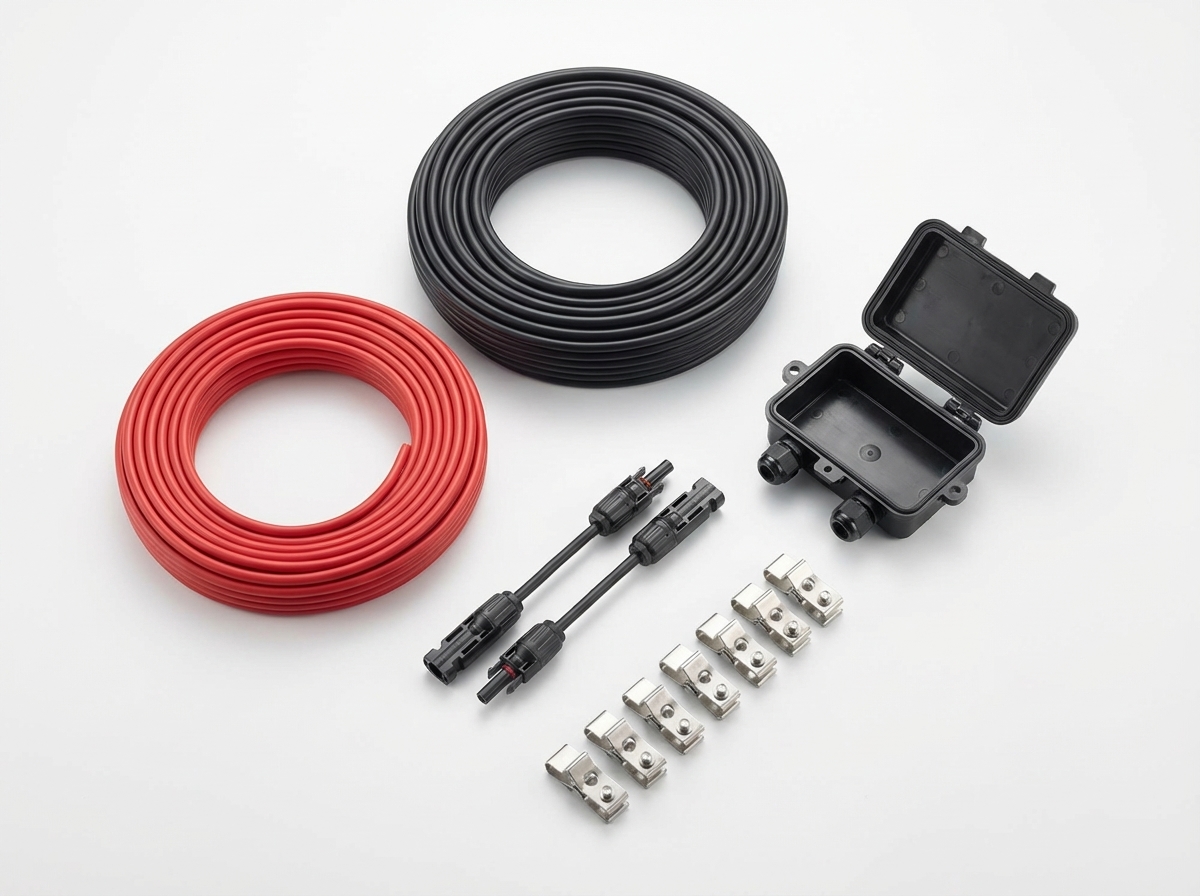
4mm² is the default PV string cable, but "what current can 4mm² carry?" has two answers: the catalogue free-air rating (around 32 A for H1Z2Z2-K) and the real, derated ampacity once you account for ambient temperature, conduit and bundling. The derated figure is what actually protects the circuit.
This guide is the focused ampacity reference. For the size-choice decision use the 4mm² vs 6mm² comparison; for full voltage-drop sizing use the PV cable sizing guide — both linked below.
What 4mm² PV cable can actually carry
H1Z2Z2-K 4mm² has a free-air reference ampacity of roughly 32 A at 30°C (IEC 60364-5-52). But a typical PV string only draws 10–14 A (module Isc), so in normal rooftop conditions 4mm² has comfortable headroom. The risk is not the string current — it is the conditions that derate the cable below its catalogue number.
Derating: when 4mm² is no longer enough
Three factors reduce the usable ampacity, and they stack. High ambient temperature (rooftops and deserts), enclosure in conduit or trunking, and bundling several cables together each apply a multiplier. In a worst-case stack the effective ampacity can fall close to the string current, removing the safety margin — that is when 6mm² or a different routing is required.
- Ambient temperature: the single biggest factor on hot rooftops
- Installation method: free-air vs conduit vs buried changes the rating
- Grouping: 4+ bundled cables reduce each cable's rating
- Always derate from the free-air figure, never quote the catalogue number as the design value
Voltage drop and certificates
Ampacity is a safety limit; voltage drop is an efficiency limit, and on long runs voltage drop usually forces an upsize before ampacity does. Confirm both. On certificates, specify the standard for the destination market — EN 50618 / IEC 62930 for EU/IEC, UL 4703 for the USA — and confirm jacket marking and reel length before order.
4mm² PV cable ampacity & derating
| Condition | Derating factor | Effective ampacity (4mm²) |
|---|---|---|
| Free air, 30°C (reference) | 1.00 | ~32 A (IEC 60364-5-52) |
| Ambient 45°C | ~0.87 | ~28 A |
| Ambient 60°C | ~0.71 | ~23 A |
| In conduit / trunking | ~0.80 | ~26 A |
| Bundled, 4+ cables | ~0.75 | ~24 A |
| Worst case: 60°C + conduit + bundled | ~0.45 | ~14 A |
Indicative, based on IEC 60364-5-52 reference and typical derating multipliers. A 10–14 A string is safe on 4mm² in most conditions, but a worst-case stack can erase the margin — confirm ambient, installation method and grouping before specifying.
Procurement decision table
| Decision area | Buyer question | Procurement check | Risk control |
|---|---|---|---|
| Product scope | Which product families does this cover? | PV Cables, H1Z2Z2-K Solar Cable | Quoting the catalogue free-air ampacity as the design value |
| Specification input | What must be stated before comparing quotes? | Module Isc (and × 1.25 for fuse) | Use the same specification wording across supplier quotes. |
| Commercial input | What makes the quote operationally useful? | Ambient temperature at the cable route | Tie quantity, packing and destination to the same RFQ line. |
| Quality gate | What should be checked before shipment? | 4mm² vs 6mm² Solar Cable | Ignoring ambient temperature on hot rooftops |
BOM and RFQ context
4mm² PV Cable Ampacity: ~32A Free-Air, Less Derated is most useful when it is read as a sourcing decision, not only an informational article. The affected product scope normally includes PV Cables, H1Z2Z2-K Solar Cable. A buyer should connect the answer to a live BOM, because cable size, connector rating, protection device choice, box configuration, storage accessories and export packing can change together.
For a procurement guide, the goal is to turn a broad buying question into a repeatable RFQ structure. The buyer should leave with the required product family, specification fields, quality checks and internal links needed to continue into the central products hub. In an RFQ, the minimum inputs should include Module Isc (and × 1.25 for fuse), Ambient temperature at the cable route, Installation method (free-air / conduit / buried), Number of bundled cables. These inputs let a sourcing team compare suppliers on the same basis instead of only comparing unit price.
The related follow-up content is 4mm² vs 6mm² Solar Cable, PV Cable Sizing Guide, BOS 1500V Selection Guide. Use those pages to validate standards, sizing, inspection and packing before sending a final quote request. The main risk to avoid is: Quoting the catalogue free-air ampacity as the design value Ignoring ambient temperature on hot rooftops
FAQ
What is the ampacity of 4mm² solar cable?
About 32 A free-air at 30°C for H1Z2Z2-K 4mm² (IEC 60364-5-52). After derating for ambient temperature, conduit and bundling it is lower — often 20–28 A in real installations, and as low as ~14 A in a hot, enclosed, bundled worst case.
Is 4mm² enough for my PV string?
Usually yes for a single string drawing 10–14 A Isc in normal conditions. Check the derated ampacity against your ambient temperature and installation method, and check voltage drop on long runs — that often forces 6mm² before ampacity does.
When should I use 6mm² instead of 4mm²?
Use 6mm² for higher-Isc modules (above ~13–15 A), long runs where voltage drop exceeds ~1–2%, or hot/enclosed/bundled routes where 4mm² derates too far. See the 4mm² vs 6mm² comparison for the full decision.