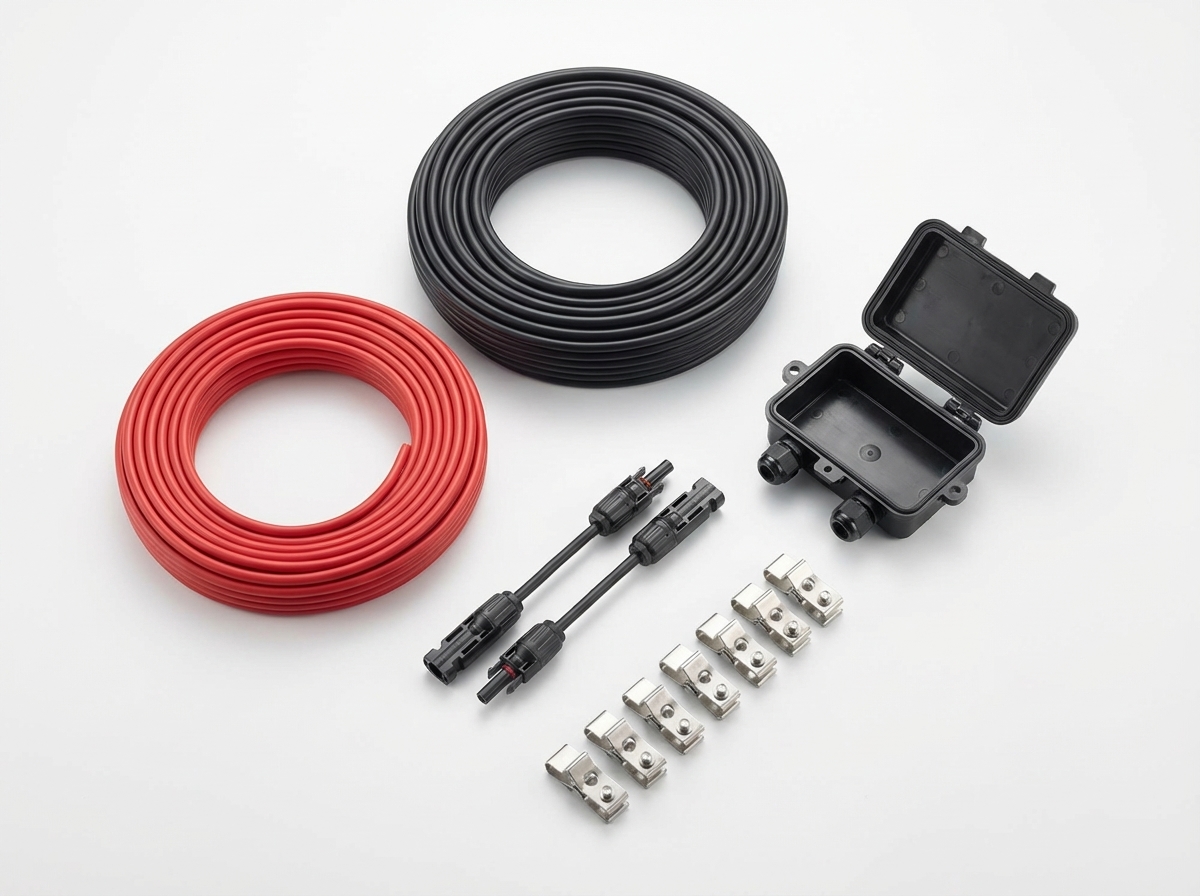
Most Chinese solar BOS factories set minimum order quantities that suit large projects and established distributors — typically one full pallet or one carton per SKU at minimum. For small installers, new importers placing a first container, or regional distributors adding a new product line, these thresholds can feel like a wall. The assumption becomes that direct China sourcing is only for large buyers.
That assumption is often wrong. Suppliers who work across multiple BOS categories can consolidate smaller requirements into workable orders. A buyer who needs a modest quantity of PV cable, connectors, DC protection devices and combiner boxes together may meet realistic minimums across the combined order even if each individual line would be too small alone. The key is knowing how to structure the inquiry.
Why MOQ exists and when it actually applies
MOQ (minimum order quantity) exists because factories and trading companies have fixed costs per production run and shipment preparation. A carton of circuit breakers takes the same warehouse handling regardless of whether it contains 10 units or 100. When a supplier sets a minimum, they are protecting the economics of serving the order.
MOQ is not a fixed law. It is a negotiating floor. Suppliers who want a new customer relationship, who have overstock, or who can package a small order as part of a consolidated shipment often flex on minimums — especially for first-time buyers showing real project intent.
- Factory MOQ is set per production run — trading companies can order below that from existing stock
- Mixed-category orders can hit workable minimums even when single-line quantities are small
- First order pricing and MOQ are often more flexible than repeat order terms
- Showing a real project BOM signals intent and typically gets a better response than a price-only inquiry
How mixed-category orders change the math
A solar installation project needs PV cable, connectors, DC circuit breakers or fuses, a combiner box and often AC protection and a distribution board. These are five or six different product categories. A buyer ordering only 20 combiner boxes might be below a reasonable minimum on that line alone. But a buyer ordering 200m of cable, 50 connector pairs, 20 DC MCBs and 5 combiner boxes is placing an order with real commercial value — even if each individual line is modest.
Suppliers who stock multiple BOS categories can serve this kind of mixed order where a single-product factory cannot. The practical implication: structure your inquiry around your full project BOM, not individual line items. The combined order is easier to say yes to.
- Send a complete BOM list, not a single-product request
- Cable + connectors + protection + combiner boxes is a natural combination that suppliers expect
- Mounting hardware can often be added to the same shipment
- Mixed orders typically consolidate in one container with one packing list
What small buyers can realistically order
Small order is relative. For BOS components, a workable small order is typically one that fills at least a portion of a 20ft container — roughly 25 to 30 cubic metres of cargo. That might be 500 to 1000 metres of PV cable, a few dozen protection devices, 5 to 20 combiner boxes and matching connectors and accessories. This is a realistic quantity for a small installer completing a few rooftop or small commercial projects per month.
For even smaller requirements — sample quantities to qualify a supplier before committing — the conversation shifts to sample orders. A sample order is typically one or a few units per product line, intended for testing and approval rather than stock. OmniSol handles both sample qualification orders and small commercial orders.
- Sample orders: 1–5 units per product line for testing and approval
- Small commercial orders: partial container quantities across multiple product lines
- Mixed container: combine BOS categories to reach a workable shipment volume
- Repeat small orders are easier to place once the supplier relationship is established
How to write a small order inquiry that gets a response
The single most effective thing a small buyer can do is send a complete BOM list with the inquiry. Not "I need PV cable" but "I need 500m of PV1-F 4mm², 100 MC4 connector pairs, 10 ETM1-63DC single-pole DC MCBs and 2 EKDBS-PV4 combiner boxes, destination Rotterdam." That inquiry tells the supplier exactly what is needed, shows project intent and allows a real quote rather than a guessing-game back-and-forth.
Include destination port, preferred Incoterms (CIF or FOB both work), and any certification requirements (TÜV, UL, EN, etc.). If you have flexibility on delivery timing, say so — orders that can ship on the supplier's schedule are often easier to accommodate at smaller quantities.
- Full product list with model numbers, ratings and quantities
- Destination port and Incoterms preference
- Required certifications for the destination market
- Target delivery window (flexible timing helps)
- Any packing or labeling requirements
Procurement decision table
| Decision area | Buyer question | Procurement check | Risk control |
|---|---|---|---|
| Product scope | Which product families does this cover? | PV Cables, Connectors, DC Protection | Single-line inquiries with no context — they get low priority |
| Specification input | What must be stated before comparing quotes? | Prepare a full BOM with product names, ratings and quantities | Use the same specification wording across supplier quotes. |
| Commercial input | What makes the quote operationally useful? | Identify your destination port and Incoterms preference | Tie quantity, packing and destination to the same RFQ line. |
| Quality gate | What should be checked before shipment? | Solar BOS Packing & Labeling Guide | Asking for price without specifying quantity or destination |
BOM and RFQ context
Buying Solar BOS from China Without Large Minimum Orders is most useful when it is read as a sourcing decision, not only an informational article. The affected product scope normally includes PV Cables, Connectors, DC Protection, Combiner Boxes. A buyer should connect the answer to a live BOM, because cable size, connector rating, protection device choice, box configuration, storage accessories and export packing can change together.
For a procurement guide, the goal is to turn a broad buying question into a repeatable RFQ structure. The buyer should leave with the required product family, specification fields, quality checks and internal links needed to continue into the central products hub. In an RFQ, the minimum inputs should include Prepare a full BOM with product names, ratings and quantities, Identify your destination port and Incoterms preference, List required certifications (TÜV, UL, CE, EN, etc.), Note any packing or labeling requirements. These inputs let a sourcing team compare suppliers on the same basis instead of only comparing unit price.
The related follow-up content is Solar BOS Packing & Labeling Guide, Solar BOS Inspection Checklist, Incoterms for Solar BOS Imports. Use those pages to validate standards, sizing, inspection and packing before sending a final quote request. The main risk to avoid is: Single-line inquiries with no context — they get low priority Asking for price without specifying quantity or destination